
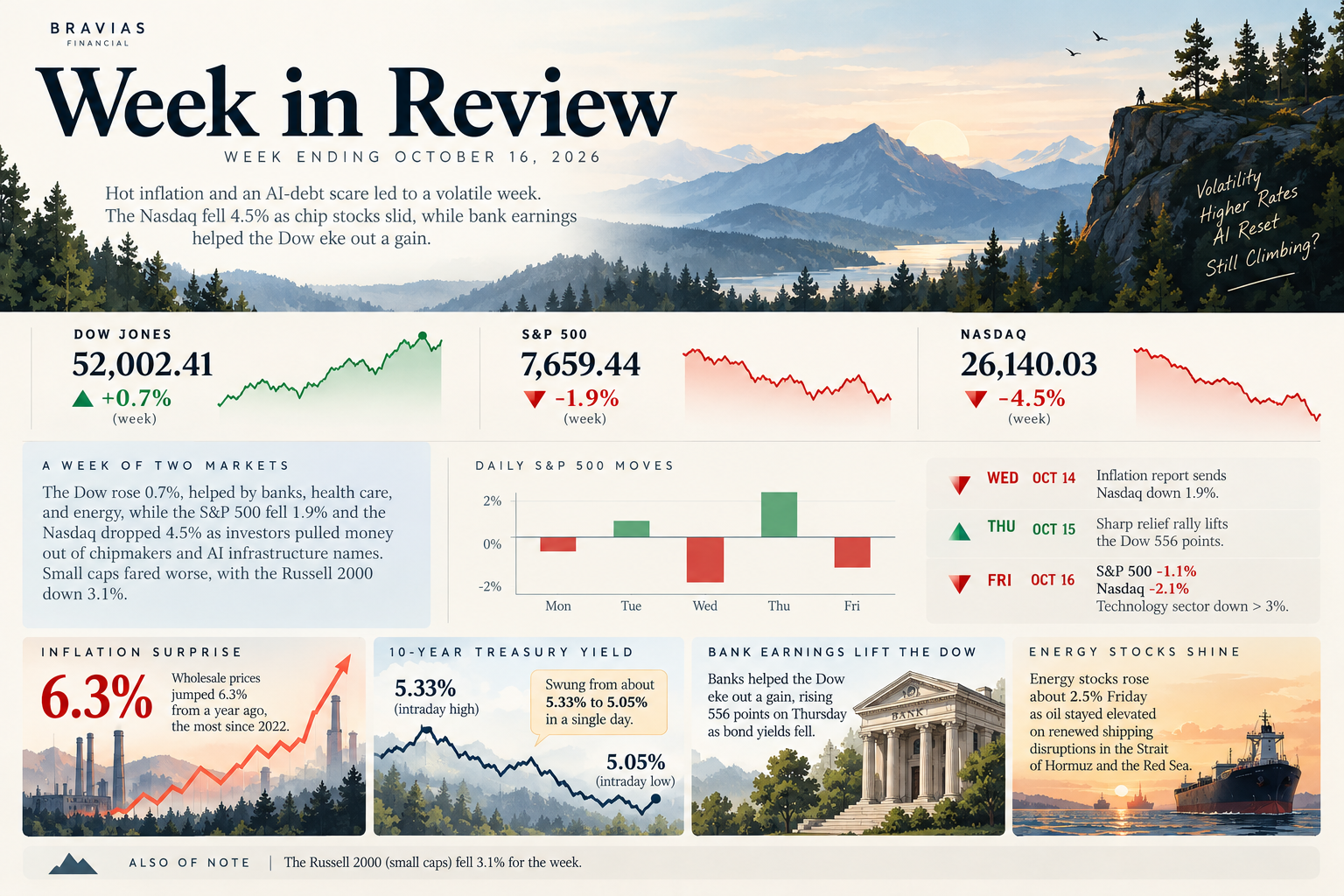
Week Ending October 16, 2026
DJIA
52,002.41
+0.7% (wk)
S&P 500
7,659.44
-1.9% (wk)
NASDAQ
26,140.03
-4.5% (wk)
Hot inflation and an AI-debt scare drag the Nasdaq down 4.5% for the week as chip stocks slide, while bank earnings help the Dow eke out a gain; wholesale prices jump 6.3% from a year ago, the most since 2022, and the 10-year Treasury yield swings from about 5.33% to 5.05% in a single day
It was a week of two markets. The Dow rose 0.7% to 52,002.41, helped by banks, health care, and energy, while the S&P 500 fell 1.9% to 7,659.44 and the Nasdaq dropped 4.5% to 26,140.03 as investors pulled money out of chipmakers and AI infrastructure names. Small caps fared worse still, with the Russell 2000 down 3.1%. Wednesday’s inflation report set the tone, sending the Nasdaq down 1.9% on the day, and Thursday brought a sharp relief rally that lifted the Dow 556 points as bond yields fell. Friday undid most of that: the S&P 500 lost 1.1%, the Nasdaq fell 2.1%, and the technology sector dropped more than 3%. Energy stocks were the bright spot, rising about 2.5% Friday as oil stayed elevated on renewed shipping disruptions in the Strait of Hormuz and the Red Sea.
Inflation heats up: September consumer prices rose 0.6% for the month and 3.7% from a year earlier, with gasoline up 9.1% and accounting for more than half of the increase. Core inflation, which excludes food and energy, rose 0.3%, above the 0.2% forecast. Thursday’s producer price report was hotter still: wholesale prices jumped 1.3% in September against a 0.5% forecast and 6.3% from a year earlier, the biggest annual gain since 2022. Real wages fell 0.5% for the month. The 10-year Treasury yield peaked near 5.33% before falling as low as 5.05% within 24 hours as investors fled to safety during the chip selloff, finishing the week near 5.1%. Fed Chair Kevin Warsh told investors Friday, “I don’t prejudge meetings,” and the odds of an October 28 hike fell to about 17% from roughly 45% Wednesday, though markets still price a hike by year-end as highly likely.
AI debt and bank results: The tech selloff centered on how the AI build-out is being financed. CoreWeave, a heavily indebted data center operator, fell about 25% over five sessions as its bond yields climbed above 15% and the cost of insuring its debt hit a record. Chip stocks fell alongside it, with the iShares Semiconductor ETF headed for a ninth straight daily decline Friday, its longest losing streak since 2006, while Super Micro, Palantir, and CrowdStrike each fell more than 7% Friday. Banks offered a counterweight. Goldman Sachs earned $17.01 a share against a $13.65 estimate on a 72% jump in equities trading and record advisory fees, and Citigroup and Wells Fargo also beat. JPMorgan missed for the first time in nearly three years on slower bond trading, and CEO Jamie Dimon warned that sticky inflation and rising rates are shifting conditions “under the surface.”
Weekly Performance
| Index | Close | %Chg (wk) |
|---|---|---|
| Dow Industrials | 52,002.41 | +0.7% |
| S&P 500 | 7,659.44 | -1.9% |
| Nasdaq Comp | 26,140.03 | -4.5% |
| Russell 2000 | 2,719.57 | -3.1% |
| 10-Yr Treasury (Fri) | ~5.1% | ~-13 bp |
Inflation Runs Hot
| Indicator | Reading | vs Est |
|---|---|---|
| CPI (YoY) | 3.7% | vs 3.6% |
| Core CPI (MoM) | 0.3% | vs 0.2% |
| PPI (MoM) | 1.3% | vs 0.5% |
| PPI (YoY) | 6.3% | Most since 2022 |
| Retail sales (MoM) | 0.8% | vs 0.3% |
Big Bank Earnings
| Bank | Q3 EPS | Result |
|---|---|---|
| Goldman Sachs | $17.01 | vs $13.65 est |
| JPMorgan Chase | $5.57 | vs $5.93 est |
| Wells Fargo | $1.87 | Beat |
| Citigroup | Profit +40% | Beat |
Weekly Movers
| Name | Notable Move |
|---|---|
| Dow (Thu) | +556 pts |
| Energy sector (Fri) | +2.5% |
| Goldman Sachs (GS) Tue | Beat, rose |
| Alcoa (AA) Fri | Rose on beat |
| Nasdaq (Wed, CPI) | -1.9% |
| CoreWeave (CRWV) 5 days | ~-25% |
| Semiconductor ETF (SOXX) | 9-day slide |
| Tech sector (Fri) | -3%+ |
| SMCI, PLTR, CRWD (Fri) | -7%+ |
| Moderna (MRNA) Fri | ~-10% |
Week Ahead
- Big Tech Earnings: Netflix reports Tuesday, October 20, and Meta and Tesla follow Wednesday. After this week’s selloff, investors want proof that AI spending is turning into revenue and cash flow.
- October 28 FOMC: Hike odds for this month fell to about 17% after Warsh declined to prejudge the meeting, but a hike by year-end remains heavily priced. Hot CPI and PPI readings keep the door open.
- AI Credit Stress: CoreWeave’s bond yields above 15% put a spotlight on debt-funded data center builders. Watch credit spreads as closely as share prices.
- Oil and Shipping: Disruptions in the Strait of Hormuz and Red Sea keep crude volatile, with Brent testing $110 intraday Friday. Gasoline drove more than half of September’s CPI increase.
- Data Calendar: September housing starts and building permits (Tuesday), then October purchasing managers’ surveys and final University of Michigan consumer sentiment (Friday).
TERM OF THE WEEK
Credit Default Swap (CDS): A contract that works like insurance on a company’s debt. The buyer pays a regular fee, and if the borrower defaults, the seller covers the loss. The fee, quoted as a spread, rises when investors grow more worried about repayment, which makes CDS prices a real-time gauge of credit risk. This week the cost of insuring CoreWeave’s debt hit a record as its bond yields climbed above 15%, reflecting concern that heavily indebted AI infrastructure companies may struggle to repay as borrowing costs rise. That worry spilled into stocks: CoreWeave fell about 25% in five sessions and helped drag the Nasdaq down 4.5% for the week. For investors, the lesson is that bond and CDS markets often flag trouble before stock prices do. When the cost of protecting a company’s debt jumps, it is worth asking how much of its growth depends on borrowing.
