
Week Ending October 30, 2026
DJIA
51,771.14
-0.9% (wk)
S&P 500
7,579.86
-0.6% (wk)
NASDAQ
25,437.00
-2.0% (wk)
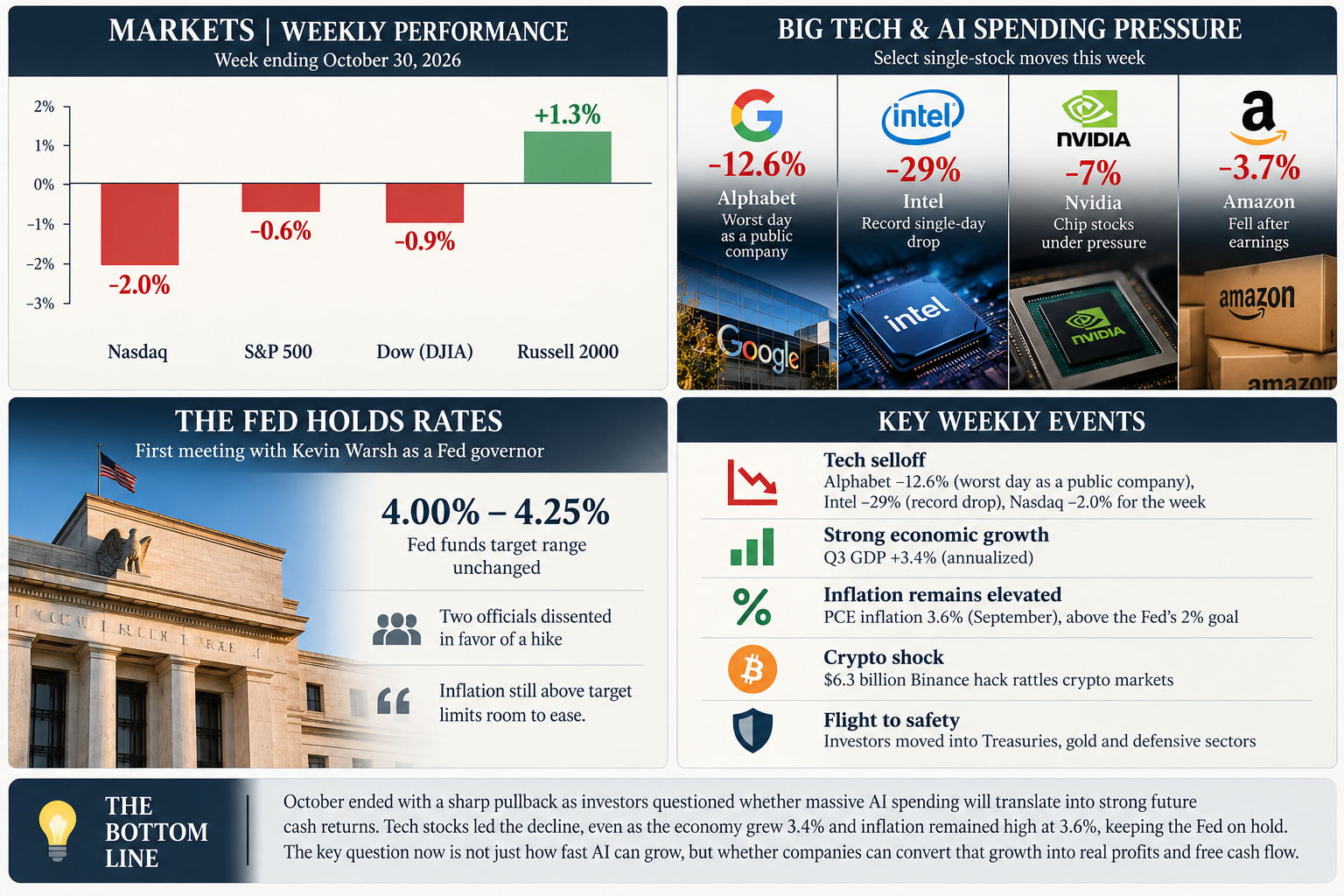
Alphabet’s worst day as a public company and a record 29% plunge in Intel drag the Nasdaq down 2.0% for the week, and more than 5% for October, as AI spending fears return; the Fed holds rates in Kevin Warsh’s first meeting as two officials dissent in favor of a hike, third-quarter GDP grows 3.4%, and a $6.3 billion Binance hack rattles crypto
October ended with a sharp selloff, as every major index fell Friday. For the week, the Dow lost 0.9% to 51,771.14, ending a three-week winning streak, the S&P 500 slipped 0.6% to 7,579.86, and the Nasdaq dropped 2.0% to 25,437.00. For October, the Dow gained 1.7% while the S&P 500 fell 0.9% and the Nasdaq lost more than 5%, its worst month since March 2025. Small caps held a weekly gain of about 1% despite Friday’s drop. The week began calmly, with Monday’s gains and a muted reaction to Wednesday’s Fed decision, but Big Tech earnings turned the mood. Alphabet fell 12.6% Thursday, and Friday’s sell-off was broad: the Dow fell 571 points, the S&P 500 1.8%, and the Nasdaq 2.9%, chip stocks dropped about 7%, and the technology sector lost 3.9%. Investors moved into safer corners: health care hit a record high and consumer staples gained. Exxon and Chevron also rose and briefly touched record highs after both beat profit estimates.
The AI spending bill: Alphabet missed revenue and profit estimates for the first time in nearly four years. Google Cloud revenue more than doubled, but quarterly capital spending of $51.4 billion pushed free cash flow negative for a second straight quarter. The stock posted its largest one-day drop since its 2004 listing. Amazon also disappointed, missing third-quarter estimates, with its free cash flow outflow over the past 12 months exceeding $42 billion, a record, as it plans to spend more next year. Intel delivered the biggest shock: despite beating third-quarter estimates, it guided fourth-quarter revenue to $15 billion to $16 billion against $17.07 billion expected, citing a weak PC market, and its shares fell 29%, their steepest one-day drop on record. Reddit fell about 24% on a soft outlook, and Coinbase and other crypto-linked stocks sank after a $6.3 billion hack at Binance.
A divided Fed: In Kevin Warsh’s first meeting as chair, the Fed held its benchmark rate at 3.75% to 4.00% in a 10-2 vote, with Governor Lisa Cook and Cleveland Fed President Beth Hammack dissenting in favor of a hike. The statement upgraded the economy to “expanding at a strong pace,” and Warsh repeated that he will not pre-judge meetings. Thursday’s data supported that view: third-quarter GDP grew at a 3.4% annual rate, beating the 3.1% forecast, while September’s PCE price index rose 0.5% for the month and 3.6% from a year earlier, its largest monthly gain since March. On Friday, St. Louis Fed President Alberto Musalem and Richmond Fed President Tom Barkin both argued rates need to rise. Futures priced roughly an 85% chance of a December 9 hike after the decision. Oil stayed elevated, with WTI near $104 a barrel, and the 10-year Treasury yield ended near 4.92%.
Weekly Performance
| Index | Close | %Chg (wk) |
|---|---|---|
| Dow Industrials | 51,771.14 | -0.9% |
| S&P 500 | 7,579.86 | -0.6% |
| Nasdaq Comp | 25,437.00 | -2.0% |
| Russell 2000 | ~2,803 | ~+1.0% |
| 10-Yr Treasury (Fri) | ~4.92% | Below 5% |
The Fed and the Economy
| Indicator | Reading | Note |
|---|---|---|
| Fed funds target | 3.75-4.00% | Held, 10-2 vote |
| Q3 GDP (annualized) | 3.4% | vs 3.1% est |
| September PCE (YoY) | 3.6% | +0.5% MoM |
| Core PCE (YoY) | 3.1% | In line |
| December hike odds | ~85% | Meets Dec 9 |
Earnings Shocks
| Company | Figure | Note |
|---|---|---|
| Alphabet Q3 capex | $51.4B | 2x+ a year ago |
| Alphabet Cloud revenue | $30.7B | +103% |
| Intel Q4 revenue guide | $15-16B | vs $17.07B est |
| Amazon 12-month FCF | -$42B+ | Record outflow |
Weekly Movers
| Name | Notable Move |
|---|---|
| Russell 2000 (wk) | ~+1.0% |
| Regeneron (REGN) Fri | Beat, raised |
| Exxon, Chevron (Fri) | Record highs |
| Health care sector (Fri) | Record high |
| Intel (INTC) Fri | -29.3% |
| Alphabet (GOOGL) Thu | -12.6% |
| Reddit (RDDT) Fri | ~-24% |
| Coinbase (COIN) Fri | ~-13% |
| AMD (AMD) Fri | ~-10% |
| Chip stocks (Fri) | ~-7% |
Week Ahead
- Midterm Elections: Voters go to the polls Tuesday, November 3. Results will shape the outlook for fiscal, energy, and trade policy heading into 2027.
- October Jobs Report (Friday, November 6): With growth strong and inflation running above 3%, a solid payroll number would strengthen the case for a December hike.
- December Hike Debate: Two dissents and hawkish remarks from Musalem and Barkin keep a December 9 increase heavily priced. October CPI follows on November 10.
- Megacaps Under Pressure: Meta and Alphabet ended the week more than 20% below their 52-week highs, Amazon 15% and Nvidia 12%. Investors want proof that AI spending will pay off in cash flow.
- Oil and Iran: WTI above $100 and signs that U.S. strikes on Iran could resume keep energy at the center of the inflation story.
TERM OF THE WEEK
Earnings Guidance: A company’s own forecast of its results for the coming quarter or year, usually issued alongside its latest earnings report. Investors often care more about guidance than about the quarter just reported, because stock prices reflect expectations for the future. Intel showed why this week. It beat third-quarter estimates, with revenue up 21%, but projected fourth-quarter revenue of $15 billion to $16 billion, well below the $17.07 billion analysts expected, and its shares fell 29% in a single day, the steepest drop in their history. Guidance also sets the bar for the next report: a company that guides low and then beats can be rewarded, while one that misses its own forecast can lose credibility. Interestingly, Fed Chair Kevin Warsh takes the opposite approach to the central bank’s version of guidance, declining to signal future rate moves outside a crisis. When reading an earnings headline, check the outlook before the results.
