
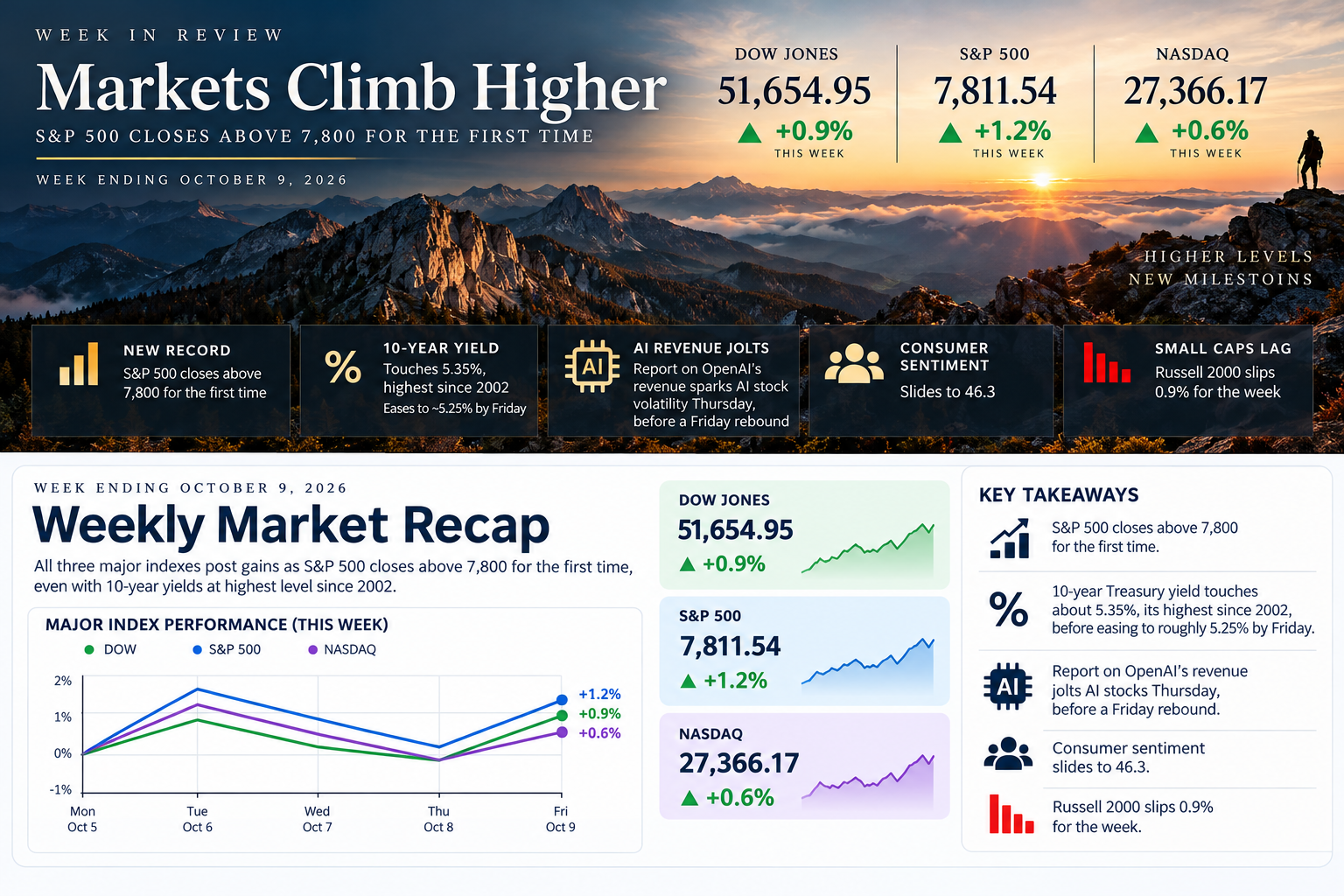
Week Ending October 9, 2026
DJIA
51,654.95
+0.9% (wk)
S&P 500
7,811.54
+1.2% (wk)
NASDAQ
27,366.17
+0.6% (wk)
The S&P 500 closes above 7,800 for the first time and all three indexes post weekly gains, even as the 10-year Treasury yield touches about 5.35%, its highest since 2002; a report on OpenAI’s revenue jolts AI stocks Thursday before a Friday rebound, and consumer sentiment slides to 46.3
Stocks shrugged off two-decade-high bond yields to finish the week higher across the board. The S&P 500 rose 1.2% to 7,811.54, the Dow gained 0.9% to 51,654.95, and the Nasdaq added 0.6% to 27,366.17, its fourth straight weekly gain. Tuesday was the high-water mark: the S&P 500 closed at a record 7,818.93, its first finish above 7,800, and the Nasdaq set a record of its own at 27,599.79. Gains faded midweek as the 10-year Treasury yield climbed to about 5.35%, its highest level since 2002, before easing to roughly 5.25% by Friday. Friday brought a broad rally, with the Dow up 423 points and software stocks rebounding sharply after a selloff driven by fears that AI will disrupt their business models. Small caps were the exception, as the Russell 2000 slipped 0.9% for the week.
AI revenue reality check: Thursday’s wobble traced to a Financial Times report that OpenAI’s annualized revenue run rate reached about $50 billion in September, roughly $20 billion below the figure that had circulated in late September. Chip, data center, and AI infrastructure stocks sold off, and the Nasdaq fell 1.3% on the day. A Bloomberg report that OpenAI expects to reach or exceed $70 billion by year-end helped calm nerves, setting up Friday’s rebound. Elsewhere, telecom stocks took a beating: AT&T, Verizon, and T-Mobile each fell more than 7% Friday as investors weighed SpaceX’s push into mobile service as a credible threat to their subscribers. Moderna jumped about 9% on reports of a national cancer vaccine initiative.
Consumers and costs: The University of Michigan’s preliminary October sentiment index fell to 46.3 from 48.1, below the 47.6 economists expected and the lowest reading since May; survey director Joanne Hsu cited frustration over rising living costs. Delta Air Lines opened earnings season with its first miss in two years, reporting adjusted earnings of $1.72 a share and cutting its 2026 outlook to $5.10 to $5.60 from $6.50 to $7.50, as fuel costs rose by about $6 billion this year. Oil stayed elevated, with Brent near $104 a barrel as Hurricane Isaias shut in roughly 63% of Gulf of Mexico output. With the Fed’s September minutes showing most officials expect another increase this year, markets lean toward an October pause and price a meaningful chance of a December hike.
Weekly Performance
| Index | Close | %Chg (wk) |
|---|---|---|
| Dow Industrials | 51,654.95 | +0.9% |
| S&P 500 | 7,811.54 | +1.2% |
| Nasdaq Comp | 27,366.17 | +0.6% |
| Russell 2000 | 2,806.98 | -0.9% |
| S&P 500 (Tue record) | 7,818.93 | 1st above 7,800 |
Treasury Yields at 24-Year Highs
| Maturity | Yield | Note |
|---|---|---|
| 10-Year (midweek high) | ~5.35% | Since 2002 |
| 10-Year (Fri) | 5.25% | Eased |
| 30-Year (Fri) | 5.61% | Near 2002 highs |
| 2-Year (Fri) | 4.80% | 2s10s ~+45 bp |
Consumers and Earnings
| Indicator | Reading | Note |
|---|---|---|
| UMich sentiment (Oct) | 46.3 | vs 47.6 est |
| Delta Q3 adj. EPS | $1.72 | Missed |
| Delta 2026 EPS guide | $5.10-5.60 | From $6.50-7.50 |
| OpenAI run rate (Sept) | ~$50B | ~$20B below talk |
Weekly Movers
| Name | Notable Move |
|---|---|
| Dow (Fri) | +423 pts |
| Humana (HUM) Fri | +12.2% |
| Crown Castle (CCI) Fri | +11.3% |
| Moderna (MRNA) Fri | +~9% |
| Software stocks (Fri) | Sharp rebound |
| Nasdaq (Thu, OpenAI) | -1.3% |
| T-Mobile (TMUS) Fri | -9.5% |
| AT&T (T), Verizon (VZ) Fri | -7%+ |
| Delta (DAL) | Missed, cut guide |
Week Ahead
- September CPI (Wednesday): The key inflation print before the October 28 FOMC. A cool reading supports a pause after September’s hike; a hot one puts October back in play and could push yields toward new highs.
- Big Banks Open Earnings (Tuesday): Major banks kick off third-quarter reporting. Net interest income, credit costs, and trading results will show how lenders are handling 5% long-term rates.
- AI Revenue Under Scrutiny: After the OpenAI report, investors will look harder at whether AI spending is turning into revenue. Expect run-rate and monetization questions on every tech earnings call.
- Oil and the Gulf: Brent near $104 and Hurricane Isaias shut-ins keep fuel costs high, as Delta’s guidance cut showed. Watch how quickly Gulf output returns.
- Holiday Schedule: Stocks trade normally Monday, October 12, but the bond market and banks are closed for Columbus Day and Indigenous Peoples’ Day.
TERM OF THE WEEK
Annualized Revenue Run Rate: An estimate of a full year’s revenue made by taking a short period of results, usually one month or one quarter, and multiplying it out to twelve months. A company that brings in $4 billion in a single month has an annualized run rate of $48 billion. Fast-growing private companies favor the measure because it reflects where the business is today rather than where it was a year ago. This week showed its limits. A report that OpenAI’s run rate was about $50 billion in September, roughly $20 billion below the figure investors had been discussing, helped send the Nasdaq down 1.3% Thursday, and a separate report that OpenAI expects to reach $70 billion by year-end helped spark Friday’s rebound. There is no standard definition, so when you see a run-rate figure, ask three questions: which period is being annualized, whether it counts gross or net revenue, and how much of that revenue actually recurs.
