
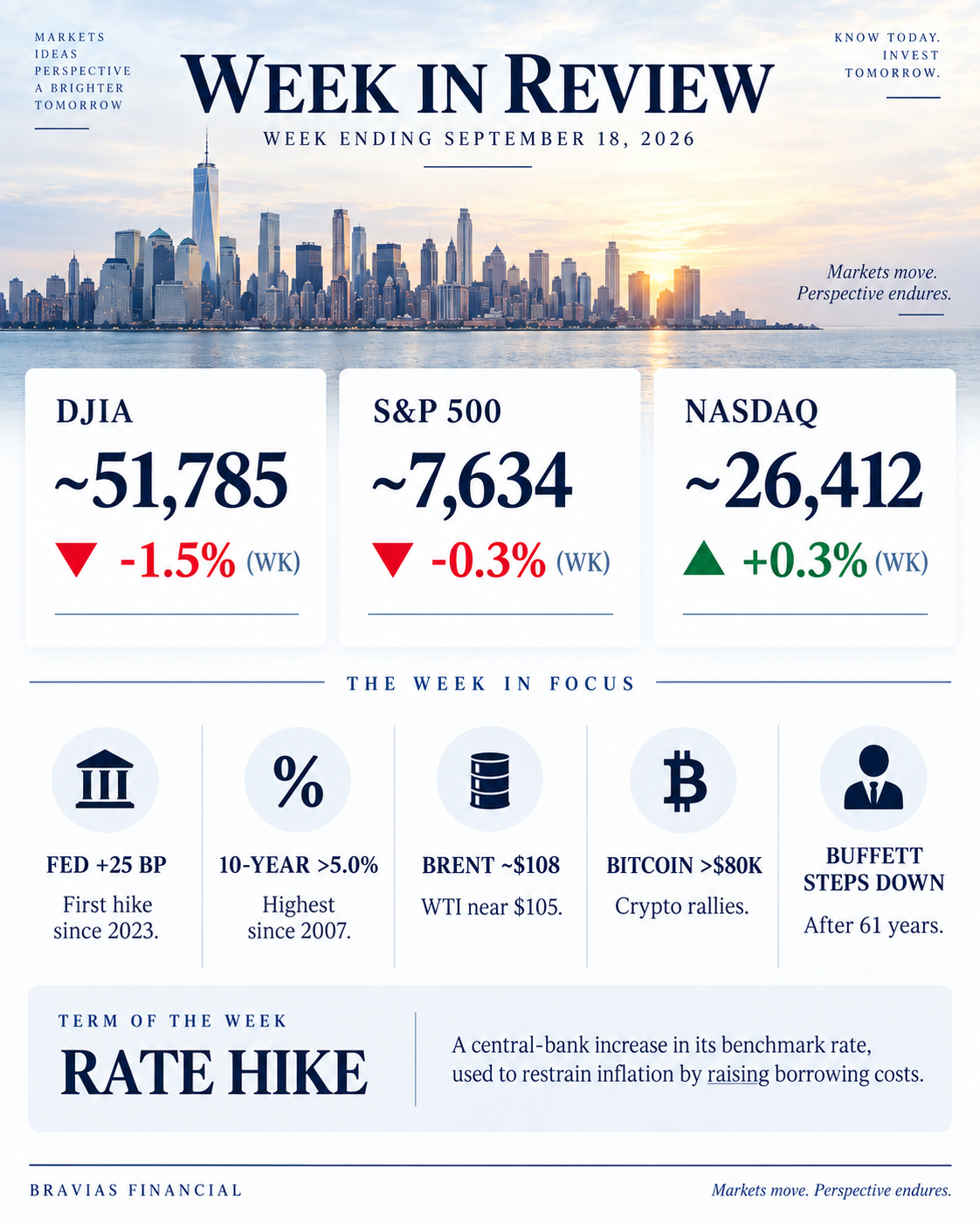
Week Ending September 18, 2026
DJIA
~51,785
-1.5% (wk)
S&P 500
~7,634
-0.3% (wk)
NASDAQ
~26,412
+0.3% (wk)
The Fed hikes for the first time in three years, lifting the target range to 3.75-4% and signaling more to come; the Dow sheds 631 points on the decision and books a third straight losing week; the 10-year yield tags a 19-year high above 5% and Warren Buffett steps down at Berkshire after 61 years
The Federal Reserve did what it had not done since 2023, and the week belonged to the consequences. In a unanimous 12-0 vote Wednesday, the FOMC raised the overnight funds rate by a quarter point to a target range of 3.75-4%—its first hike in more than three years—explicitly to combat inflation driven by spiraling oil prices, and the median projection pointed to one or two additional increases this year alongside upward revisions to both inflation and growth forecasts. The reaction was swift: the Dow fell 631.21 points (-1.21%) Wednesday to 51,461.90 as Chair Kevin Warsh used his press conference to stress persistent inflation, with the S&P 500 down 0.45% to 7,551.81 and the Nasdaq essentially flat at 25,978.42. All three had been higher before the decision. A powerful Thursday rebound—the S&P up 1.1%, the Nasdaq up 1.7%—recovered much of the damage as yields stabilized and big-cap technology and chips caught a bid, but Friday’s triple-witching session gave part of it back. For the week the Dow fell roughly 1.5% to near 51,785, its third consecutive weekly loss and worst month-to-date showing among the majors; the S&P slipped about 0.3% to around 7,634; and the Nasdaq eked out a gain of roughly 0.3% to near 26,412, its resilience the week’s quiet story.
The bond market, not the stock market, remained the center of gravity. The 10-year Treasury yield climbed above 5% to touch its highest level since July 2007, extending a relentless repricing driven by the twin fears of oil-fed inflation and a Fed now actively tightening into it. The two-year yield, which had ripped higher on Wednesday’s hike, saw that move erased Thursday as the front end stabilized, but the long end stayed elevated and the dollar headed for its best week since May. Oil sat at the heart of the inflation story: Brent hovered near $108 and WTI around $105 as Saudi Arabia and Yemen’s Houthis exchanged fresh strikes across their border Thursday, expanding the conflict, though crude came off its highs late in the week after reports that China had reached out to Iran about reining in the Houthis. Senator Elizabeth Warren cited a Congressional Budget Office estimate that the Iran war has cost the Department of Defense nearly $40 billion and driven “nearly half” of U.S. inflation. Kansas City Fed President Jeff Schmid said Friday he backed the hike and suggested more could be warranted—a view echoed across the committee.
Two milestones outside the rate decision marked the week. Warren Buffett, 96, announced Friday he is stepping down as chairman of Berkshire Hathaway effective immediately, becoming chairman emeritus while remaining on the board; his son Howard succeeds him as chairman, with Greg Abel continuing as chief executive. Buffett has led the roughly trillion-dollar conglomerate since 1965, compounding returns at 19.7% annually—about double the S&P 500—over his tenure, and economist Mohamed El-Erian called the handoff “a masterclass in corporate succession.” Berkshire shares declined modestly on the news. Separately, Anthropic selected the Nasdaq for its planned initial public offering, a vote of confidence in the AI trade even as several industry leaders publicly urged a development slowdown; the choice extends a remarkable IPO pipeline that has already brought SpaceX and SK Hynix to market this year. Crypto rallied despite Washington dysfunction—bitcoin surged past $80,000 as the SEC proposed a framework for tokenized stock trading, filling the void left when the CLARITY Act failed in the Senate. Netflix fell nearly 5% on a Wells Fargo downgrade, and SpaceX slipped after pushing its next Starship launch to September 28.
Weekly Performance
| Index | Close | %Chg (wk) |
|---|---|---|
| Dow Industrials | ~51,785 | -1.5% |
| S&P 500 | ~7,634 | -0.3% |
| Nasdaq Comp | ~26,412 | +0.3% |
| Dow (Wed, hike) | -631 pts | -1.21% |
| Dow week streak | 3rd loss | In a row |
The Fed Hike (Wednesday)
| Detail | Value | Note |
|---|---|---|
| Move | +25 bp | 1st since 2023 |
| Target range | 3.75-4% | From 3.5-3.75% |
| Vote | 12-0 | Unanimous |
| 2026 dot median | 1-2 more | Hikes ahead |
| Revisions | CPI, GDP up | Jobless down |
Yields, Oil and Dollar
| Indicator | Level | Note |
|---|---|---|
| 10-Yr Treasury | >5.0% | Since Jul ’07 |
| Brent Crude | ~$108 | Houthi strikes |
| WTI Crude | ~$105 | Off highs late |
| U.S. Dollar | Best wk | Since May |
Weekly Movers
| Name | Notable Move |
|---|---|
| Bitcoin (BTC) | >$80,000 |
| Chips/big tech (Thu) | Led rebound |
| Nasdaq (Thu) | +1.7% |
| Berkshire (BRK) Fri | Modest dip |
| Netflix (NFLX) Fri | -5% |
| Goldman Sachs (GS) Wed | -3.9% |
| IBM Wed | -4.3% |
| Boeing (BA) Wed | -3.7% |
| SpaceX (SPCX) Fri | Slipped |
Week Ahead
- Trump-Xi Summit: AI, the trade war, and the yuan dominate next week’s meeting. A Goldman survey shows 46% of offshore investors expect Chinese stocks to rise on the outcome; guardrails or concessions on tech competition would move global markets.
- One or Two More Hikes: The dot plot signals additional tightening this year, and Schmid plus the broader committee back it. With the 10-year above 5%, every inflation and oil print now reads directly into the pace of what comes next.
- Yields Through 5%: The 10-year at a 19-year high is the dominant risk. If oil holds near $108 and the long end keeps climbing, Thursday’s tech-led rebound will struggle regardless of earnings—duration-sensitive names remain most exposed.
- Gulf Diplomacy: Trump meets leaders of Saudi Arabia, the UAE, Qatar, Bahrain, Kuwait, and Oman next week, weighing whether to “annihilate” or negotiate. China’s outreach to Iran on the Houthis is the first de-escalation signal in weeks; the oil tape hangs on it.
- Anthropic and the IPO Pipeline: The Nasdaq selection keeps the AI listing wave alive after SpaceX and SK Hynix. Whether frontier-AI names can price into a 5% rate environment tests investor appetite for long-duration growth.
Term of the Week
Rate Hike: An increase in the central bank’s benchmark short-term interest rate, the Fed’s primary tool for cooling demand and containing inflation by raising the cost of borrowing throughout the economy. Wednesday’s quarter-point move to a 3.75-4% target range was the first hike in more than three years, and its significance lies less in the 25 basis points than in the reversal of direction it represents. For most of the past two years markets debated when the Fed would cut; the question is now how many more times it will raise, with the dot plot pointing to one or two additional increases before year-end. The mechanism runs through every corner of the market: higher policy rates lift the whole yield curve’s anchor (the 10-year pierced 5% for the first time since 2007), raise the discount rate on future earnings (compressing long-duration growth valuations most), increase borrowing costs that slow credit-fueled expansion, and strengthen the dollar as higher yields draw capital. What makes this hike unusual is its cause. The Fed is not tightening because the economy is overheating but because an external supply shock—the Iran war’s effect on oil, which one CBO estimate blames for nearly half of current inflation—has pushed prices up in a way rate policy cannot directly fix. Raising rates cannot produce a barrel of oil; it can only suppress demand broadly enough to offset the energy shock, risking slower growth even as it fights prices. That is the box Warsh is in, and why the reaction was so conflicted: a hike into supply-driven inflation is both necessary for credibility and blunt as a remedy. For investors, the regime shift matters more than the single move. A tightening Fed with oil above $100 and yields above 5% inverts the playbook that governed the prior cycle—cash and short-duration assets earn more, leverage costs more, and the assumption that the Fed will rescue falling markets no longer holds while inflation is the binding constraint.
