
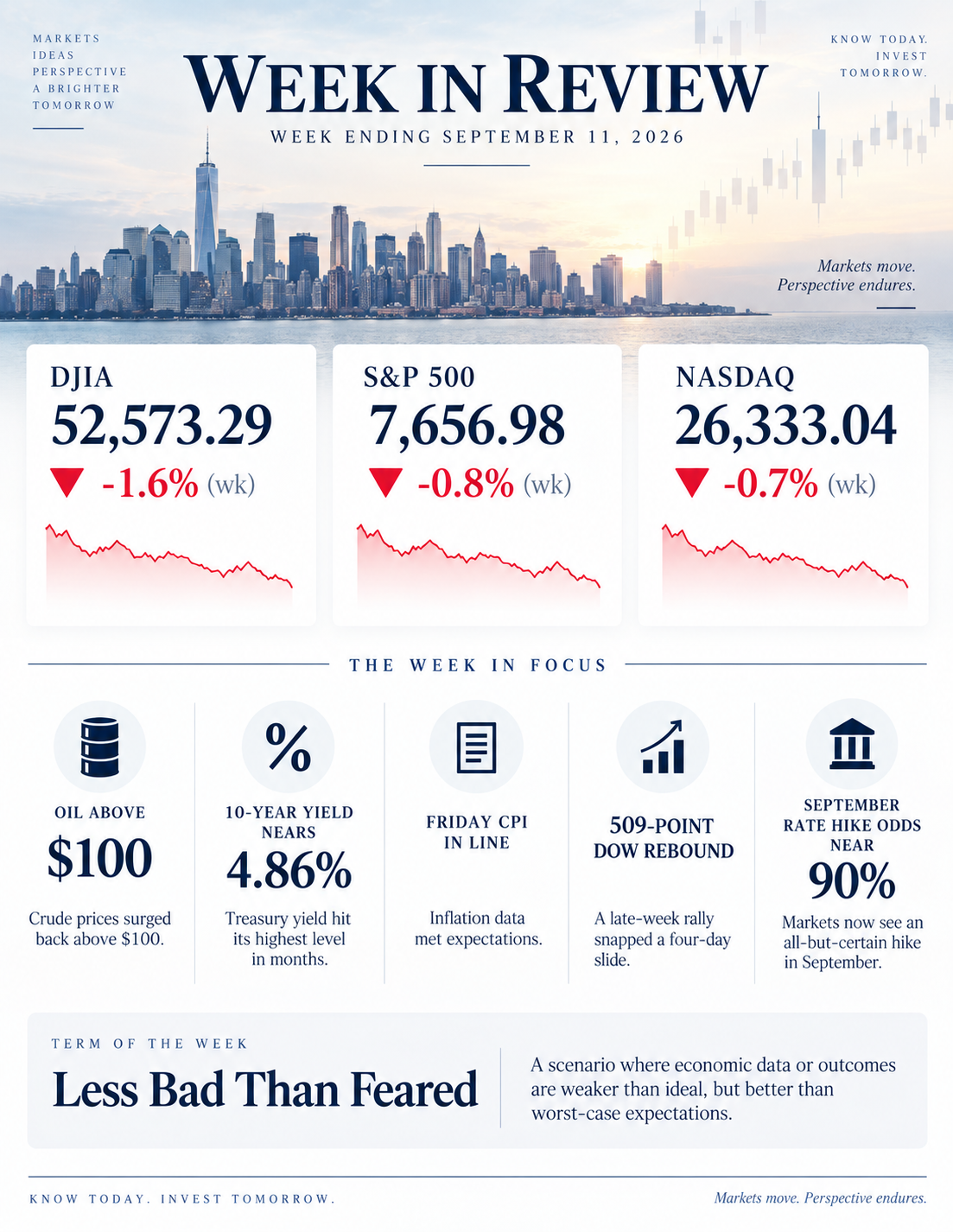
Week Ending September 11, 2026
DJIA
52,573.29
-1.6% (wk)
S&P 500
7,656.98
-0.8% (wk)
NASDAQ
26,333.04
-0.7% (wk)
Oil above $100 and a 10-year yield near 4.86% drive the Dow to its worst week since March; Friday’s in-line CPI and a pullback in crude spark a 509-point rebound that snaps a four-day slide—but seals an all-but-certain September rate hike, now priced near 90%
The week that will define the Fed’s September decision was dominated not by the central bank but by the oil market and the bond market, which together dragged equities to their worst weekly showing since March before a Friday relief rally pared the damage. All three indexes finished lower for the week even after Friday’s bounce: the Dow fell 1.6% to 52,573.29, the S&P 500 declined 0.8% to 7,656.98, and the Nasdaq slipped 0.7% to 26,333.04. The catalyst all week was energy. West Texas Intermediate rallied nearly 10% and Brent almost 9% as the United States and Iran traded strikes across the Persian Gulf, with WTI climbing for six straight sessions to breach $100 and Brent topping $108 intraday. Rising crude fed straight into the bond market: the 10-year Treasury yield reached 4.857% on Wednesday, its highest since November 2023, after the Treasury Department said it would triple its buyback of longer-dated debt to $6 billion—an escalation from the doubling announced weeks earlier that nonetheless failed to hold yields down. The combination of triple-digit oil and two-decade-high yields is the textbook squeeze on equity valuations, and it produced four consecutive down days before Friday.
Friday delivered the relief the week had been denied. The August consumer price index rose 0.4% for the month, putting headline inflation at 3.4% year-over-year, matching July and landing in line with expectations. Core CPI rose 0.3%, a tenth hotter than forecast on the month, but the annual core rate eased to 2.4% from 2.5%. Crucially, the report was not the upside shock investors had braced for after a week of $100 oil, and crude finally cooled—WTI fell 2.4% to settle at $100.05 and Brent slid 2.8% to $104.61, easing the pressure on long-dated yields. Stocks seized on the reprieve: the Dow jumped 509.19 points (+0.98%), the S&P climbed 0.86%, the Nasdaq rose 0.96%, and the Russell 2000 added 1.04%, snapping the four-day losing streak that had been the Dow’s longest since late April. The paradox of the session was stark—the probability of a September rate hike actually rose to roughly 90% from about 70% mid-week, yet stocks rallied anyway, because Wall Street had spent days preparing for something worse and simply needed the news to be less bad than feared.
The energy shock rippled well beyond the pump. Saudi Arabia shut its crucial East-West crude pipeline as a precaution after attacks in the Riyadh and Madinah regions caused multiple injuries, and U.S. diesel prices hit a record high as Middle East shipping disruptions stoked supply fears; refiners Valero, Phillips 66, PBF, Marathon, HF Sinclair, and Delek all touched 52-week highs Friday. The International Energy Agency cut its oil-demand forecast and warned consumption may fall further as the war drags on, now projecting 2026 world supply to decline about 6%. Away from energy, the AI trade found footing: Oracle surged 5.5% after reporting a jump in cloud-infrastructure revenue, with that unit representing the majority of its $664 billion backlog, and the rally broadened Friday as Hewlett Packard Enterprise gained nearly 11% and Dell rose about 11% on an RBC outperform initiation. The August federal budget gap shrank 52% from a year earlier to $167 billion, helped by lower interest payments and ongoing refunds of tariffs collected before the Supreme Court’s February ruling. The European Central Bank raised rates as expected, setting up a week of major central-bank decisions culminating in the FOMC.
Weekly Performance
| Index | Close | %Chg (wk) |
|---|---|---|
| Dow Industrials | 52,573.29 | -1.6% |
| S&P 500 | 7,656.98 | -0.8% |
| Nasdaq Comp | 26,333.04 | -0.7% |
| Dow (Friday) | +509 pts | +0.98% |
| Dow week | Worst | Since March |
August CPI (Friday)
| Indicator | Reading | vs Est |
|---|---|---|
| Headline MoM | +0.4% | In line |
| Headline YoY | 3.4% | Matched July |
| Core MoM | +0.3% | Tenth hot |
| Core YoY | 2.4% | From 2.5% |
| Sept hike odds | ~90% | From ~50% |
Oil, Yields and Rates
| Indicator | Level | Note |
|---|---|---|
| WTI Crude (Fri) | $100.05 | Week +~10% |
| Brent Crude (Fri) | $104.61 | Week +~9% |
| 10-Yr Treasury (Wed) | 4.857% | Since Nov ’23 |
| Treasury buyback | $6B | Tripled |
Weekly Movers
| Name | Notable Move |
|---|---|
| HPE (Fri) | +11% |
| Dell (DELL) Fri | +11% |
| Oracle (ORCL) Fri | +5.5% |
| Cisco (CSCO) Fri | +4.1% |
| Refiners (VLO/PSX/MPC) | 52-wk highs |
| Dow (Tue, oil) | -628 pts |
| Dow (Wed, yields) | -405 pts |
| Seagate (STX) Fri | -3.4% |
| Nike (NKE) week | 52-wk low |
Week Ahead
- FOMC Wednesday: Markets price a September hike at roughly 90% after the in-line CPI removed the last excuse for patience. The question is no longer whether Warsh moves but how many more hikes he signals with oil above $100.
- Oil Is the Macro Variable: WTI rallied 10% on U.S.-Iran strikes before Friday’s pullback. Saudi Arabia’s pipeline shutdown and record diesel prices keep energy inflation live; every dollar of crude pressures the yields squeezing stocks.
- Yields Near Two-Decade Highs: The 10-year hit 4.857% and Treasury tripled buybacks to $6 billion without lasting effect. If yields resume their climb toward 5%, Friday’s relief rally will prove fragile regardless of the Fed.
- AI Trade Stabilizes: Oracle’s $664 billion backlog, plus HPE and Dell surging, gave the sector its first clear win in a week of AI gloom. Whether it holds depends on rates, not fundamentals, in the near term.
- Central-Bank Cluster: The ECB hiked as expected; the FOMC and other majors follow next week. A synchronized hawkish turn against $100 oil would tighten global conditions into an already jittery tape.
Term of the Week
Less Bad Than Feared: The market dynamic in which an asset rises not because the news is good but because it is not as bad as investors had already positioned for—the outcome clears a lowered bar, and the relief of avoiding the worst case is itself the catalyst. Friday was a clean example. By any straightforward reading, the day’s news argued for lower stocks: August CPI held at 3.4%, core inflation ran a tenth hotter than expected on the month, and the probability of a September rate hike jumped to roughly 90% from about 50% a week earlier. Yet the Dow rallied 509 points and every major index gained roughly 1%. The explanation is entirely in the positioning that preceded it. Wall Street had endured four straight losing sessions, watched oil surge past $108, and seen the 10-year yield approach 5%, and it walked into Friday braced for a CPI report that could deliver a fresh inflation shock. When the print merely matched expectations and oil pulled back, the feared catalyst failed to materialize, and prices that had already discounted something worse snapped back. The mechanism matters for interpreting rallies. A “less bad than feared” advance is a relief rally, not a fundamental re-rating: it reflects the exhaustion of sellers and the unwinding of hedges rather than genuine improvement in earnings or policy. Such rallies are real and tradable but fragile, because the underlying conditions—$100 oil, two-decade-high yields, and a Fed about to hike—remain in place. When a market rises on objectively negative news, the gain is borrowed against sentiment that can reverse as fast as it turned, and it should not be mistaken for the all-clear. Friday’s bounce relieved a week of pressure; it did not remove the oil price or the yield backdrop that created it, and next week’s Fed decision will test whether the relief has any foundation beneath it.
