
Week Ending September 4, 2026
DJIA
53,414.25
-0.3% (wk)
S&P 500
7,718.60
+0.1% (wk)
NASDAQ
26,506.99
+0.4% (wk)
August payrolls triple expectations at 162,000 with June and July revised up, pushing September hike odds to 58% and ending the week’s rally; U.S. and Iran trade fire for the first time in a month; Tesla drops 6% on Cybercab debut and Lululemon craters 18%
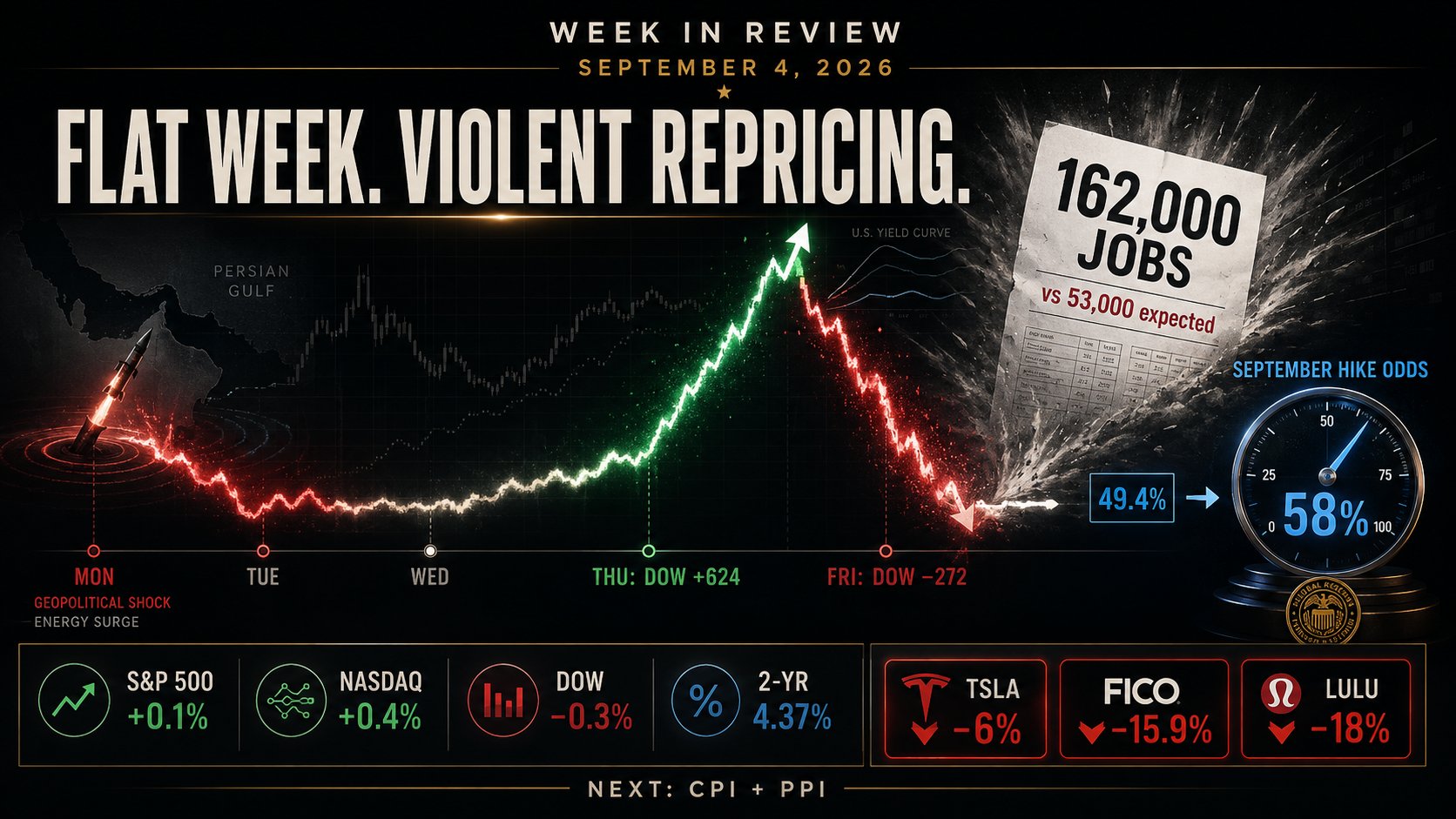
A whipsaw week ended with the major averages roughly where they started, as a monster August jobs report reversed a powerful two-day rally and revived the case for a September rate hike. Friday’s payrolls showed the economy added 162,000 jobs against the 53,000 economists expected, with unemployment holding at 4.1% and both June and July revised upward. Stocks and short-dated bonds sold off in tandem: the Dow fell 271.86 points (-0.51%) to 53,414.25, the S&P 500 slid 0.38% to 7,718.60, the Nasdaq dropped 0.29% to 26,506.99, and the Russell 2000 lost 1.4%. The two-year Treasury yield, most sensitive to imminent Fed action, rose four basis points to 4.37%, its highest since January 2025, as longer maturities outperformed. Fed funds futures moved to a 58% probability of a September hike from 49.4% a day earlier, and Northlight’s Chris Zaccarelli called it a textbook case of good news being bad news. For the week the S&P edged up 0.1% and the Nasdaq gained 0.4% while the Dow slipped 0.3%. Fifth Third’s Bill Adams framed the setup precisely: the report focuses the Fed squarely on inflation, and next week’s CPI and PPI releases now have the power to decide whether it hikes or holds.
The week opened on geopolitics rather than data. U.S. Central Command confirmed a strike on two rocket launchers on Iran’s Larak Island—the first publicly acknowledged U.S. attack on Iranian positions since late July—with Iranian state media reporting retaliatory strikes on American bases in Jordan. The Dow tumbled 374.09 points Monday to 53,185.90 as Goldman Sachs and Alphabet weighed, though the session still closed out August with the index’s fifth consecutive winning month. Tuesday brought further losses and higher oil as new strikes landed. The reversal came Wednesday and accelerated Thursday, when the Dow surged 624.16 points (+1.18%) to 53,686.11, the S&P jumped 1.06% to 7,747.71, and the Nasdaq climbed 1.4% to 26,584.06. The dollar did much of the work: the Dollar Index broke below 99 for the first time since late August and the greenback fell nearly 2% against the yen, its steepest drop since July 30. Thursday’s data was mixed: jobless claims were little changed, but the trade deficit surged on rising imports of technology-related goods as the AI buildout continues.
The political pressure on the Fed grew louder and more contradictory. Vice President JD Vance said Thursday the central bank should cut rates to make housing more affordable, days after Warsh used his Jackson Hole address to signal the opposite. Following Friday’s report, President Trump praised the number on Truth Social while threatening to cut off trade with certain countries if the Fed does not lower rates. Governor Waller struck a more measured tone, indicating his September bias will be determined by August inflation data and expressing a preference for holding if disinflation resumes—comments that briefly pulled hike pricing back toward 50%. Single stocks provided the week’s sharpest moves. Tesla fell more than 6% Friday after its long-awaited Cybercab launch left analysts with more questions than answers, erasing the prior session’s gains and marking its worst day since July 23. Lululemon plunged 18% on declining revenue and a cut to its outlook, and Fair Isaac dropped nearly 16% after the Federal Housing Finance Agency publicly criticized its pricing. Memory names bucked the tape, with Sandisk and Micron advancing. Gold slipped to a session low of $4,419 and finished down about 2% on the week.
Weekly Performance
| Index | Close | %Chg (wk) |
|---|---|---|
| Dow Industrials | 53,414.25 | -0.3% |
| S&P 500 | 7,718.60 | +0.1% |
| Nasdaq Comp | 26,506.99 | +0.4% |
| Russell 2000 (Fri) | Small caps | -1.4% |
| Dow (August) | 5th month | Winning streak |
August Jobs Report
| Indicator | Reading | vs Est |
|---|---|---|
| Nonfarm payrolls | +162,000 | vs +53,000 |
| Unemployment | 4.1% | As expected |
| June and July | Revised up | Both months |
| July (prior print) | -23,000 | Volatile series |
| Sept hike odds | 58% | From 49.4% |
Rates, Dollar and Gold
| Indicator | Level | Note |
|---|---|---|
| 2-Yr Treasury | 4.37% | Since Jan ’25 |
| 10-Yr Treasury | ~4.77% | Long end firm |
| Dollar Index (Thu) | Below 99 | Yen -2% |
| Gold (Dec, Fri) | $4,419 | Week -2% |
Weekly Movers
| Name | Notable Move |
|---|---|
| Dow (Thu session) | +624 pts |
| Nasdaq (Thu) | +1.4% |
| S&P 500 (Thu) | +1.1% |
| Sandisk, Micron (Fri) | Bucked tape |
| Dow (Fri) | -272 pts |
| Dow (Mon, Iran) | -374 pts |
| Russell 2000 (Fri) | -1.4% |
| Tesla (TSLA) Fri | -6%+ |
| Fair Isaac (FICO) Fri | -15.9% |
| Lululemon (LULU) Fri | -18% |
Week Ahead
- CPI and PPI Decide It: With payrolls removing the labor-market excuse for patience, next week’s inflation prints become the swing vote on September. Adams called the decision finely balanced; Waller said his bias hinges on exactly this data.
- Fed Independence Under Strain: Vance urging cuts for housing affordability and Trump threatening trade cutoffs unless rates fall, against a chair signaling hikes, is an unusually public split. Watch whether it hardens Warsh’s resolve or clouds the message.
- Iran Flare-Ups Resume: The Larak Island strike and Iranian retaliation in Jordan ended a month of relative quiet. Renewed escalation would lift energy costs into precisely the inflation data the Fed says will decide September.
- Consumer Cracks Widen: Lululemon’s 18% drop on a guidance cut follows Walmart’s miss and Home Depot’s caution. Discretionary retail keeps disappointing even as payrolls surprise to the upside.
- Dollar Weakness: The Dollar Index broke below 99 and the yen posted its strongest week in months. A softer dollar eases financial conditions the Fed may be trying to tighten, and it lifts import costs at the margin.
Term of the Week
Payroll Revisions: The routine restatement of monthly job counts as the Bureau of Labor Statistics collects late survey responses, typically revising each month twice over the following two reports. The revisions are ordinary bookkeeping; what makes them consequential is that markets and the Fed react to the first estimate as though it were final. A month ago the July report showed the economy losing 23,000 jobs against expectations for an 80,000 gain—a shock that took a September hike off the table and helped drive stocks to records on the reasoning that a weakening labor market would restrain the Fed. Friday’s August report showed a gain of 162,000, roughly triple consensus, and revised both June and July upward. The labor market that justified the rally four weeks ago has been substantially rewritten. Janus Henderson’s Bradford Smith made the point directly: the payroll statistic has become highly volatile, and the September hike probability moved to 58% from 49.4% in a single session on one print. Three sources drive the noise: the establishment survey samples a fraction of employers and late responses skew the initial count; the birth-death model estimates jobs at newly formed and closed businesses that cannot be surveyed in real time; and seasonal adjustment on a base of roughly 160 million jobs turns rounding-level error into tens of thousands of positions. The discipline for investors is to treat any single payroll number as one noisy observation rather than a turning point, watching the three-month average and the revision pattern instead—a framing that would have counseled against both the euphoria following July’s contraction and Friday’s abrupt repricing. The Fed faces the same problem with higher stakes: Warsh says his committee needs confidence that underlying trends have improved, and the labor data is supplying less of it than the headlines suggest.
