
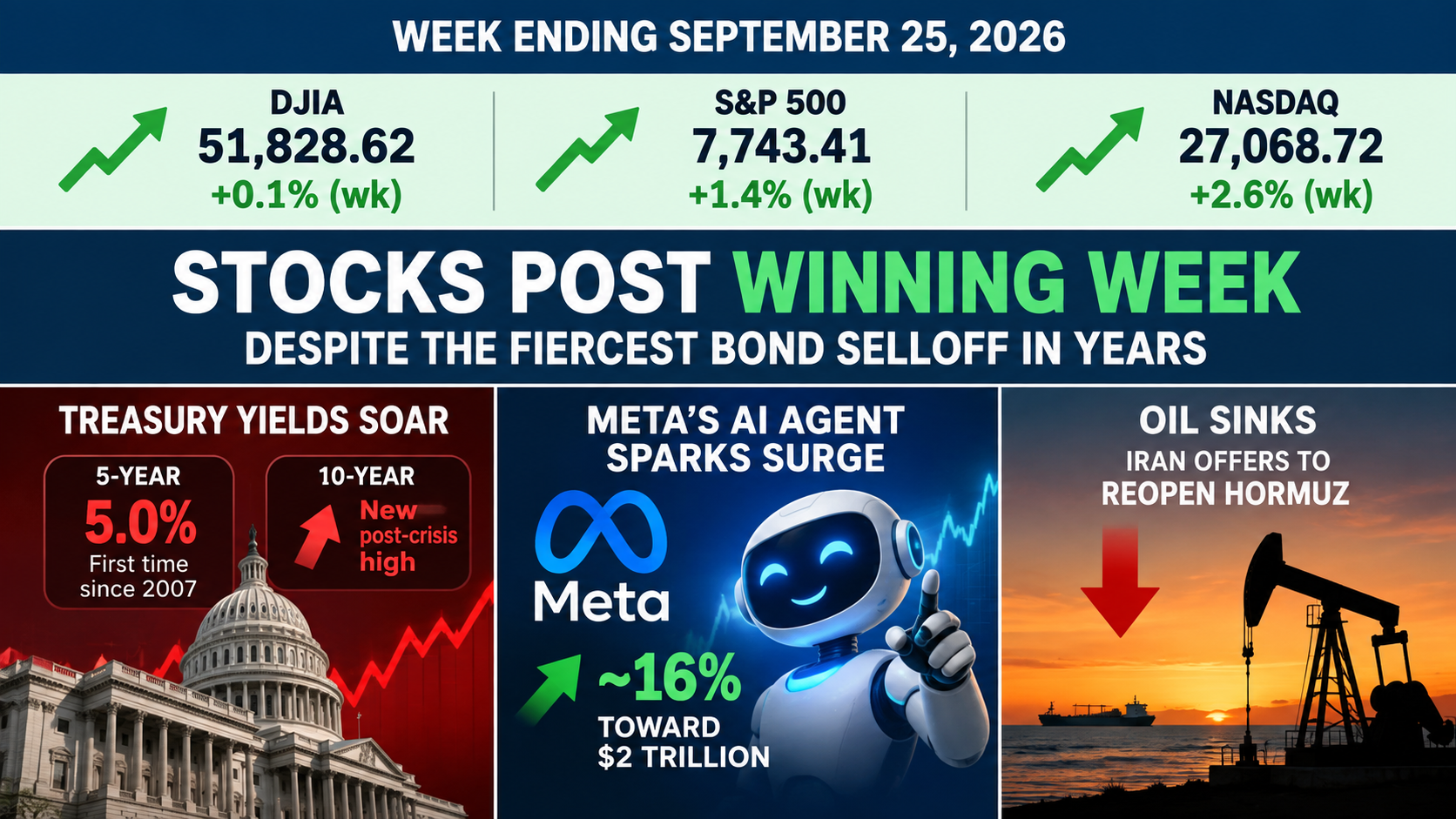
Week Ending September 25, 2026
DJIA
51,828.62
+0.1% (wk)
S&P 500
7,743.41
+1.4% (wk)
NASDAQ
27,068.72
+2.6% (wk)
Stocks post winning week despite the
fiercest bond selloff in years—the 5-year Treasury tags 5% for the
first time since 2007 and the 10-year cracks a new post-crisis high;
Meta’s viral Muse AI agent rockets the stock ~16% toward $2 trillion;
oil sinks as Iran offers to reopen Hormuz
Wall Street shrugged off a violent week in the bond market to
close higher across the board, with Friday’s rally sealing gains for
all three indexes even as Treasury yields surged to levels last seen
before the financial crisis. Friday’s close: the Dow jumped 478.64
points (+0.93%) to 51,828.62, the S&P 500 climbed 0.51% to 7,743.41,
and the Nasdaq rose 0.5% to 27,068.72. For the week the Nasdaq gained
about 2.6%, the S&P roughly 1.4%, and the Dow eked out a small advance
to snap a three-week losing streak—the tech-heavy benchmarks doing the
heavy lifting while the blue chips lagged. The engine was Monday’s
explosive session, when the Nasdaq surged 2.26% to a record close of
27,122.09, its first record since June, as Intel popped 12%, AMD
gained about 10% to reach a $1 trillion market cap, and Qualcomm rose
more than 9%. That AI-driven melt-up gave the week a cushion it
needed, because the bond market spent the following days testing
investors’ nerve. The CBOE Volatility Index was set for its biggest
weekly jump in more than a year even as equities finished green, a
divergence that captured the week’s essential tension: rising prices
sitting atop rising anxiety.
The bond market was the story beneath the story. The five-year
Treasury yield hit 5% for the first time since 2007, the ten-year
cracked a fresh post-financial-crisis high above 5.18% on Thursday,
and Wall Street could not agree on the cause—whether stubborn
inflation, resilient growth, or the exploding federal deficit was
driving the surge. The unifying fear was simpler: that higher rates
are now structurally entrenched, and that something eventually breaks
under their weight. Treasury Secretary Scott Bessent’s move weeks
earlier to triple long-dated debt buybacks to $6 billion had done
little to arrest the climb. Relief finally came Friday from an
unlikely source—the oil market. Crude slid as optimism built that the
Strait of Hormuz could reopen, after Iran asked the United States to
return to the June memorandum of understanding that had failed to end
the conflict; one report described a “phased deal” and an Iranian
offer to reopen the strait within seven days and resume nuclear talks.
West Texas Intermediate fell 2.33% to settle at $92.41 and Brent
dropped 2.14% to $104.32, down roughly 5% on the week, easing the
inflation pressure that had been feeding the bond rout and letting
yields retreat from their multi-decade highs into the close.
Meta Platforms was the week’s marquee mover. The launch of its
consumer AI agent, Muse, unveiled at Meta Connect on Wednesday, hit a
viral moment that catapulted the stock roughly 16-17% over the five
sessions and pushed its market capitalization to about $1.98 trillion,
within striking distance of the $2 trillion milestone and just below
its August 2025 record. The enthusiasm carried a sharp side effect: as
Muse showed it could help consumers shop for better deals, financial
and consumer-facing names—Charles Schwab, JPMorgan, and the KBW Nasdaq
Bank Index—tumbled about 2.6% Tuesday on fears that AI agents could
erode banks’ pricing power over customer cash. On the macro-diplomacy
front, President Trump and President Xi Jinping wrapped two days of
meetings Friday, announcing a November AI-safety summit in Shenzhen,
while Bessent said the two nations agreed to extend their trade truce
by two months. Consumer sentiment darkened: the University of Michigan
index fell to 48.1 in September from 51.7 in August as elevated
grocery and gas prices weighed, with the short-run business outlook
plunging. Akamai rose 3% Friday on a multiyear deal with Anthropic,
and gold hit a fresh cycle high near $4,339.
Weekly Performance
| Index | Close | %Chg (wk) |
|---|---|---|
| Dow Industrials | 51,828.62 | +0.1% |
| S&P 500 | 7,743.41 | +1.4% |
| Nasdaq Comp | 27,068.72 | +2.6% |
| Nasdaq (Mon record) | 27,122.09 | +2.26% |
| Dow streak | Snapped | 3-wk skid |
The Bond Selloff
| Indicator | Level | Note |
|---|---|---|
| 5-Yr Treasury | 5.0% | Since 2007 |
| 10-Yr Treasury (Thu) | 5.18% | Post-crisis high |
| VIX (weekly) | Biggest jump | In over a year |
| U.S. Dollar | Firmer | Yen 158 |
Oil, Gold and Sentiment
| Indicator | Level | Note |
|---|---|---|
| WTI Crude (Fri) | $92.41 | -2.3% |
| Brent Crude (Fri) | $104.32 | Wk -~5% |
| Gold (spot, oz) | ~$4,339 | Cycle high |
| UMich sentiment | 48.1 | From 51.7 |
Weekly Movers
| Name | Notable Move |
|---|---|
| Meta (META) week | +~16% |
| Intel (INTC) Mon | +12% |
| AMD Mon ($1T cap) | +~10% |
| Qualcomm (QCOM) Mon | +9% |
| Akamai (AKAM) Fri | +3% |
| Alphabet (GOOGL) Thu | +1.3% |
| KBW Bank Index (Tue) | -2.6% |
| Charles Schwab (SCHW) Tue | -2.6% |
| Berkshire (BRK) Mon | -0.8% |
Week Ahead
- The 5% World: With the 5-year at 5% and the 10-year above 5.18%, higher-for-longer is no longer a forecast but a condition. Every rate-sensitive corner—housing, credit, long-duration tech valuations—now reprices against a curve anchored near 5%.
- Hormuz Phased Deal: Iran’s offer to reopen the strait within seven days and resume nuclear talks is the first concrete de-escalation in weeks. If crude keeps falling, it removes the supply-shock inflation that pushed the Fed to hike; if talks stall, oil snaps back and the bond rout resumes.
- Meta at $2 Trillion: Muse’s viral launch put Meta within a whisker of the milestone and reframed AI agents as a consumer product. The bank-stock selloff it triggered is the tell to watch—agentic AI as a margin threat to incumbents is a new market theme.
- Consumer Cracks Deepen: UMich sentiment at 48.1, with the short-run business outlook plunging on fuel and trade worries, extends the weak-consumer signal from Walmart and Lululemon. Watch whether it starts bleeding into hard spending data.
- Trade Truce Extended: The two-month Trump-Xi extension and the November Shenzhen AI-safety summit buy time on tariffs. The detente is a tailwind, but critical minerals and AI competition remain unresolved.
Term of the Week
Higher for Longer: The regime in which
interest rates settle at an elevated level and stay there, rather than
spiking and quickly reverting—forcing every asset, borrower, and
business model to be repriced against a persistently higher cost of
capital. This week made the phrase concrete: the five-year Treasury
yield reached 5% for the first time since 2007, and the ten-year
cracked a fresh post-financial-crisis high, extending a bond selloff
that has roiled markets worldwide. What distinguishes it from an
ordinary rate spike is that the repricing is anchored by the five-year
point of the curve, which reflects the expected average policy rate
over the medium term—and at 5%, it is saying the Fed’s hiking cycle is
no brief detour. Wall Street cannot agree on the driver, and the
disagreement is itself telling: stubborn inflation, resilient growth,
and an exploding deficit each argue for higher yields through
different channels, but all three point the same way. The consequences
compound: mortgage rates near multi-year highs freeze housing,
corporate refinancing grows costlier as pandemic-era debt matures, and
long-duration growth stocks face steeper discount rates on distant
cash flows—which is why this week’s leadership was narrow, resting on
AI names with visible near-term earnings like Meta. Most important,
the regime removes the reflex that governed the prior decade: the
assumption that the Fed cuts at the first sign of stress. With
inflation still the binding constraint and oil only just beginning to
ease, the central bank cannot ride to the rescue—the deeper meaning of
the week’s unease, as the VIX posted its biggest weekly jump in over a
year even while stocks rose. For portfolios, the discipline is to stop
treating elevated yields as temporary: cash earns real returns again,
leverage carries genuine cost, and the question is not when rates
fall, but which business models were built for a world where they do
not.
