
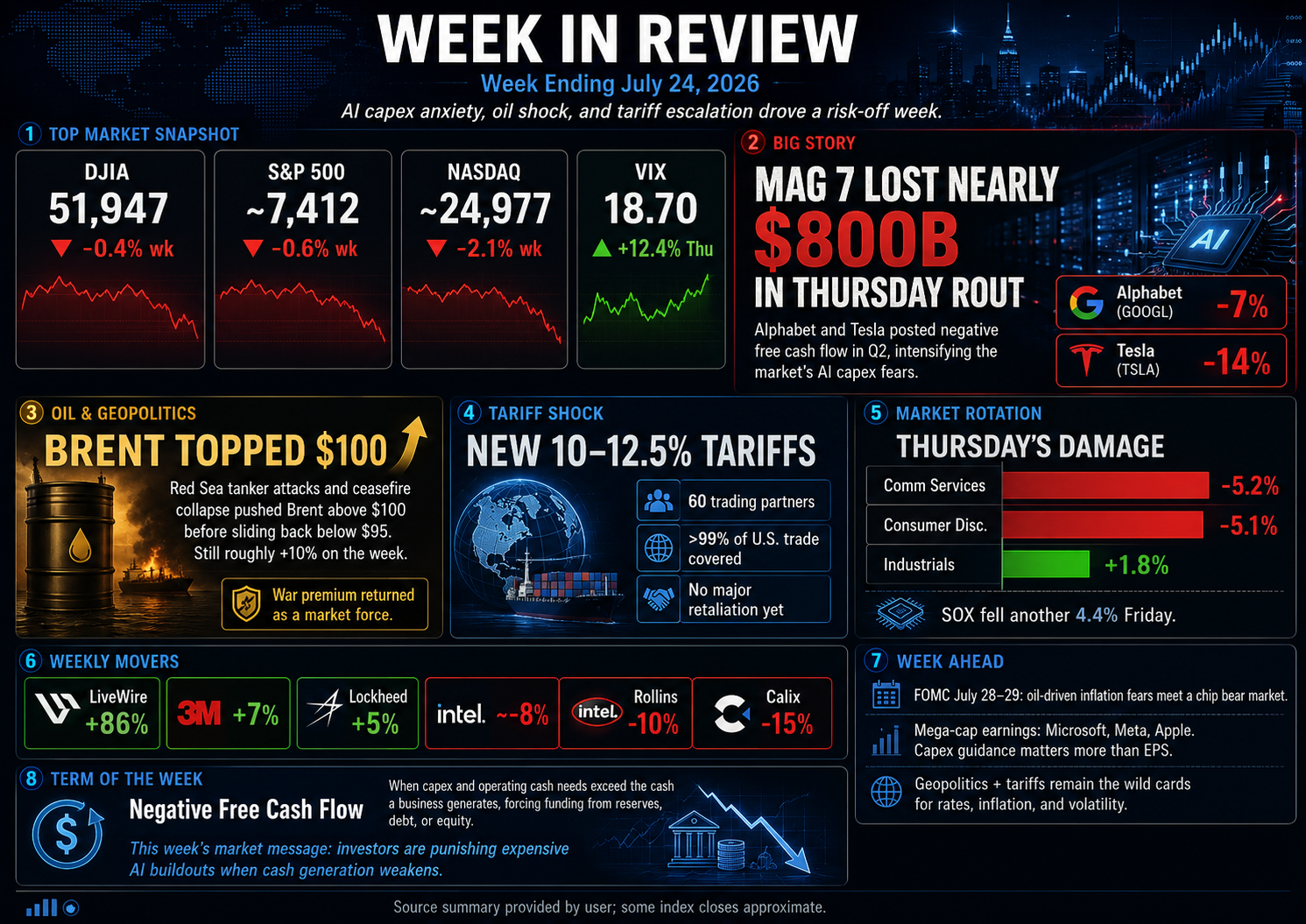
Week Ending July 24, 2026
DJIA
51,947
-0.4% (wk)
S&P 500
~7,412
-0.6% (wk)
NASDAQ
~24,977
-2.1% (wk)
Magnificent Seven shed $800 billion in Thursday rout as Alphabet and Tesla post negative free cash flow; Brent tops $100 after Red Sea tanker attacks and ceasefire collapse; new 10-12.5% tariffs hit 60 trading partners; Intel’s best revenue growth in 15 years still can’t beat the capex fear
The AI-spending reckoning and a rapidly re-escalating Iran war combined to hand markets a third straight weekly Dow decline and second consecutive losses for the S&P 500 and Nasdaq. Friday’s stabilization—Dow +235.37 points (+0.46%) to 51,947.02 on a 3% Apple jump, S&P 500 up 0.05% to roughly 7,412, Nasdaq -0.64% to near 24,977—couldn’t repair Thursday’s damage: a 506.93-point Dow drop (-0.97%) to 51,711.65, the S&P down 1.21% to 7,408.30 (breaking below its 50-day moving average near 7,470), and the Nasdaq off 2.15% as the Magnificent Seven collectively shed nearly $800 billion in market value. The VIX spiked 12.4% Thursday to 18.70. The proximate trigger was Wednesday evening’s earnings from Alphabet and Tesla: Alphabet earned $9.11 per share on $103.62 billion in revenue—far surpassing estimates—yet fell 7% Thursday as ballooning AI capital expenditure dominated the call; Tesla plunged 14% as automotive revenue beat but margins deteriorated on weaker pricing and shrinking regulatory-credit income. Critically, both companies posted negative free cash flow for the second quarter—hard evidence for the capex-anxiety thesis that has driven the chip complex into bear territory. Semiconductors couldn’t escape: the SOX sank another 4.4% Friday, and communication services (-5.2%) and consumer discretionary (-5.1%) were Thursday’s worst sectors while industrials (+1.8%) caught rotation flows.
The Iran war returned as a market-level force after the ceasefire’s formal collapse. U.S. Central Command has now conducted more than ten consecutive nights of strikes since President Trump declared the ceasefire “over,” following the deaths of three American service members, while Tehran’s forces struck U.S. military assets across the region. The conflict expanded to a new theater Thursday when Yemen’s Iran-backed Houthis claimed attacks on two Saudi tankers in the Red Sea, driving Brent crude above $100 per barrel for the first time since May 26. Trump warned that every Iranian attack on Hormuz shipping will be answered by destroying “an Iranian bridge or power plant,” and told Axios Thursday he will soon decide on a “massive attack… bigger than anything seen in the war so far,” saying Iran has not “received enough pain yet.” Oil’s inflation feedback loop hit bonds: the 10-year Treasury yield touched its highest level since early last year, and traders increased bets on Fed rate hikes in coming months—days ahead of the July 28-29 FOMC meeting. Friday brought partial relief: Reuters reported Pakistan is exploring a path toward new U.S.-Iran peace negotiations, with the push initiated by China, and Brent slid 5% back below $95—still up roughly 10% for the week. Gold and silver rallied earlier in the week as havens, with silver jumping 5% Tuesday.
Washington added a tariff shock to the mix: overnight into Friday, new duties of 10% to 12.5% took effect on 60 trading partners covering more than 99% of U.S. trade, citing alleged forced-labor violations—replacing the temporary 10% global tariffs imposed after the Supreme Court struck down most of the “liberation day” regime in February. Australia, Brazil, Chile, and New Zealand rejected the justification; notably, no major partner has announced retaliation. The White House exempted some energy products. Earnings otherwise remained strong beneath the mega-cap drama: with roughly 66 S&P 500 companies reporting by mid-week, nearly 88% had beaten bottom-line estimates per FactSet. Tuesday’s session (+0.89% S&P, breaking a three-day losing streak) was powered by 3M (+7%) and GM (+5%) beats; Lockheed Martin surged 5% Friday on a $7.94 EPS beat and record $230 billion backlog including a $35 billion THAAD contract; Oracle rose 3% on a Pentagon software contract worth up to $7 billion; and Nvidia disclosed a 9.3% passive stake in Nebius (+6%). Intel delivered the week’s most telling reversal: its sharpest quarterly revenue growth in nearly 15 years ($16.1 billion, +25%) with beats and raised guidance produced an early rally that collapsed into a roughly 8% decline—punished for planned spending increases. SK Hynix fell 3.5% in Seoul after exhausting its 2.5% ADR conversion cap, freezing arbitrage against its large U.S. premium. July’s flash PMI showed business activity expanding at the fastest pace in eight months, boosted by the World Cup.
Weekly Performance
| Index | Close | %Chg (wk) |
|---|---|---|
| Dow Industrials | 51,947.02 | -0.4% |
| S&P 500 | ~7,412 | -0.6% |
| Nasdaq Comp | ~24,977 | -2.1% |
| VIX (Thu) | 18.70 | +12.4% |
| Brent (wk) | <$95 | ~+10% |
Thursday’s Rout
| Metric | Move |
|---|---|
| Mag7 market value | -$800B |
| Tesla (TSLA) | -14% |
| Alphabet (GOOGL) | -7% |
| Comm Services (XLC) | -5.2% |
| Cons Discretionary (XLY) | -5.1% |
| Industrials (XLI) | +1.8% |
New Tariff Regime (Fri)
| Feature | Detail |
|---|---|
| Duty range | 10-12.5% |
| Trade partners | 60 |
| U.S. trade covered | >99% |
| Retaliation announced | None yet |
Weekly Movers
| Stock | Notable Move |
|---|---|
| LiveWire (LVWR) Fri | +86% |
| 3M (MMM) Tue | +7% |
| Lockheed (LMT) Fri | +5% |
| GM Tue | +5% |
| Apple (AAPL) Fri | +3% |
| Oracle (ORCL) Fri | +3% |
| Intel (INTC) Fri | ~-8% |
| Rollins (ROL) Thu | -10% |
| Tesla (TSLA) Thu | -14% |
| Calix (CALX) Mon | -15% |
Week Ahead
- FOMC July 28-29: Warsh’s second meeting arrives with oil-driven inflation fears colliding with a chip bear market. Rate-hike bets rose this week as the 10-year touched multi-quarter highs. A hawkish surprise into this tape would be combustible; September remains the live meeting.
- Mega-Cap Earnings Gauntlet: Microsoft, Meta, and Apple report next week. After Alphabet and Tesla’s negative-FCF shock erased $800B from the Mag7, capex guidance—not EPS—is what markets will trade. Meta’s ~$22B/GW cost claim faces its audit.
- “Massive Attack” Decision: Trump says the choice on a strike “bigger than anything seen in the war” comes soon. Against it: the Pakistan/China-brokered negotiation track reported Friday. Brent’s $95-$100 range is pricing maximum uncertainty.
- Tariff Digestion: 10-12.5% duties on 99% of trade with no retaliation yet—markets barely reacted Friday, but pass-through to goods prices lands just as oil rekindles inflation. Watch the Fed’s read.
- Chip Bear Market, Week Two: SOX fell another 4.4% Friday even as the broader tape stabilized. Intel’s post-earnings reversal shows good results no longer suffice—the market wants spending discipline, and no chipmaker can credibly promise it mid-arms-race.
Term of the Week
Negative Free Cash Flow: The condition in which a company’s capital expenditures and operating cash needs exceed the cash its business generates—meaning it consumed rather than produced cash for the period, and must fund the gap from reserves, debt, or equity. Free cash flow (operating cash flow minus capex) is the metric Wall Street treats as the truest measure of self-funding power, and this week it became the AI trade’s fault line. Alphabet and Tesla both reported negative free cash flow for the second quarter, and the response was unambiguous: Alphabet fell 7% despite earning $9.11 per share on $103.62 billion in revenue, Tesla dropped 14%, and the Magnificent Seven lost nearly $800 billion of market value in a session. The significance is structural: for two decades, mega-cap tech’s defining virtue was cash generation at scale. The AI buildout has inverted that identity—data centers, custom silicon, and power infrastructure now consume capital faster than even $100 billion quarters replenish it. Three consequences follow. First, funding pressure: the spending must come from somewhere, explaining the year’s pattern of Alphabet’s $80 billion raise, Meta’s secondary, and hyperscaler debt—each a claim on returns not yet visible. Second, valuation fragility: when near-term cash flow is negative, the entire valuation rests on terminal assumptions about AI payoff, making stocks hypersensitive to any evidence (a Kimi K3, a DeepSeek chip) that the payoff may be smaller or shared. Third, discipline signaling: Intel’s Friday reversal—an early rally on its best revenue growth in fifteen years collapsing into an 8% decline once management outlined two more years of higher spending—shows markets now punish capex plans on sight. Context matters: negative FCF isn’t inherently bad—Amazon ran cash-negative for years building what became AWS. The question is whether today’s AI capex is that (investment ahead of demonstrable demand) or the 1999 fiber glut (capacity racing past monetization). Next week’s Microsoft, Meta, and Apple reports move the debate: capex peaking with revenue accelerating supports the Amazon analogy; more spending with vague monetization feeds the glut thesis—and with the Fed meeting the same week amid $95 oil, the margin for disappointment is thin.
