
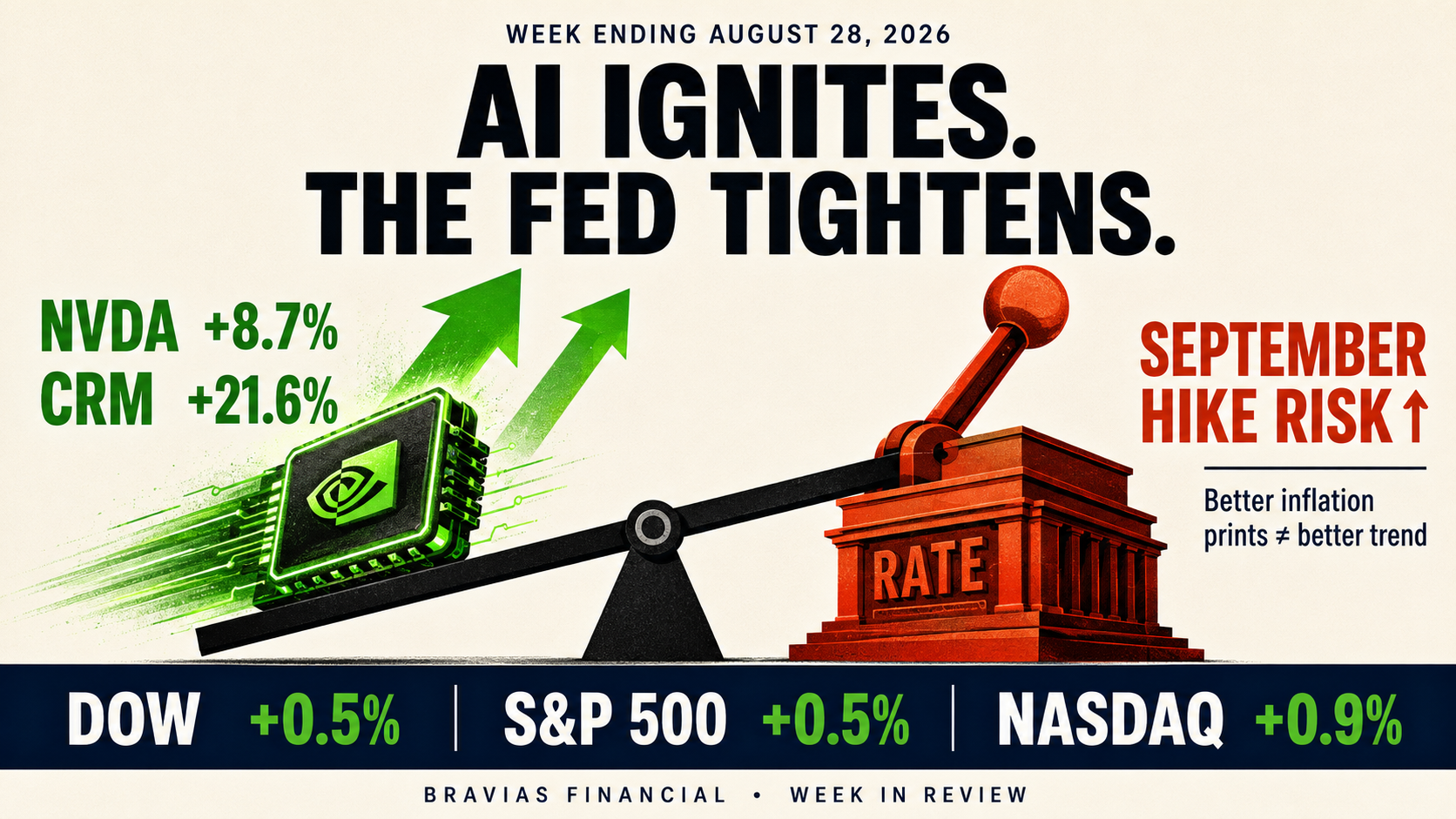
Week Ending August 28, 2026
DJIA
53,559.99
+0.5% (wk)
S&P 500
7,711.76
+0.5% (wk)
NASDAQ
26,402.42
+0.9% (wk)
Nvidia’s blowout quarter lifts the tape 8.7% and Salesforce rockets 21.6%, delivering the Dow its first winning week in three—then Warsh uses his first Jackson Hole address to warn that better inflation prints do not mean better trends, raising the odds of a September hike
All three indexes posted winning weeks despite giving back ground Friday, as a blowout Nvidia quarter and a broad software rally outweighed a hawkish debut from the Fed chair at Jackson Hole. The S&P 500 fell 0.25% Friday to 7,711.76 but gained 0.5% on the week; the Nasdaq slid 0.52% to 26,402.42 for a 0.9% weekly advance; and the Dow finished essentially flat, down 9.45 points to 53,559.99, up 0.5% for the week and snapping a two-week losing streak. Semiconductors led Friday’s give-back, with Nvidia and Intel among the laggards. In his first address at the central bank’s annual Wyoming symposium, Kevin Warsh said that while this summer’s PCE and CPI readings came in better than expected, they do not tell him that underlying trends have meaningfully improved, adding that the Fed must be confident underlying inflation is headed the right way. Principal Asset Management’s Seema Shah read it plainly: the risk of a September hike has increased, and the market’s constructive reaction shows investors place a premium on policy clarity even when that clarity is hawkish. Chicago Fed President Austan Goolsbee said he agreed with the chairman’s analysis that inflation has been running above target and remains the main problem.
Nvidia supplied the week’s fuel. Reporting Wednesday after the close, the chipmaker delivered second-quarter earnings of $2.22 per share against a $2.09 consensus on projected revenue near $92 billion, paired with a solid growth forecast—and the stock jumped 8.7% Thursday, its first decisive break after eight losing sessions in nine. The reaction rippled outward: the Nasdaq climbed roughly 1.5% Thursday as software joined the rally, with Salesforce exploding 21.6%, IBM adding 3.8%, and CrowdStrike, Okta, and Veeva all surging on results. Capital.com’s Daniela Hathorn had framed the print as bigger than a single company’s earnings given Nvidia’s role as a barometer for the entire AI investment cycle, and at a market capitalization above $5 trillion it is the largest S&P 500 member. Even so, Nvidia has added less than 13% in 2026, a marked slowdown from its recent run, and Thursday’s advance was narrower than it looked—decliners outnumbered advancers on the NYSE. Separately, Nvidia paused some arrangements under a financing initiative that had extended credit support to AI cloud providers.
The macro backdrop cooperated for most of the week. July PCE arrived Wednesday running slightly hotter than expected on the headline, but core PCE came in as anticipated—the measure Northlight’s Chris Zaccarelli called the important one, holding constant and buying the Fed more time to leave rates on hold. Bond yields cooperated too, with the 10-year falling more than seven basis points Tuesday to 4.625% after CNBC reported the Treasury could tap its $1 trillion General Account to fund bond repurchases, a meaningful retreat from the prior week’s near-20-year highs at the long end. Oil fell more than 5% on the week as Washington shifted to economic pressure on Iran: Brent dropped 3.9% Tuesday to $88.58 and WTI lost 3.1% to $82.36 following fresh sanctions on Iran and the enablers still trading with it, while Iran and Oman discussed a temporary joint shipping route through Hormuz. Monday was the week’s weak spot, with a chip selloff dragging the S&P down 0.28% as Micron fell 5.8%, Sandisk 6%, and the semiconductor ETF 2.7%. PayPal slumped 16% in Friday premarket trading after Advent and Stripe abandoned their pursuit of the company.
Weekly Performance
| Index | Close | %Chg (wk) |
|---|---|---|
| Dow Industrials | 53,559.99 | +0.5% |
| S&P 500 | 7,711.76 | +0.5% |
| Nasdaq Comp | 26,402.42 | +0.9% |
| Dow streak | 1st win | In three weeks |
| VIX (Thursday) | 14.51 | -4.6% Thu |
Warsh at Jackson Hole
| Signal | Reading | Note |
|---|---|---|
| Summer CPI/PCE | Better than est | Trend unchanged |
| September hike risk | Increased | Per Principal AM |
| Goolsbee | Agrees | Above target |
| Market read | Clarity valued | Hawkish but clear |
Rates, Oil and Inflation
| Indicator | Level | Note |
|---|---|---|
| 10-Yr Treasury (Tue) | 4.625% | -7bp+ |
| Core PCE (July) | In line | Held constant |
| Brent Crude (Tue) | $88.58 | -3.9% |
| WTI Crude (Tue) | $82.36 | Week -5%+ |
Weekly Movers
| Stock | Notable Move |
|---|---|
| Salesforce (CRM) Thu | +21.6% |
| Nvidia (NVDA) Thu | +8.7% |
| IBM Thu | +3.8% |
| Merck (MRK) Thu | -2.3% |
| Disney (DIS) Thu | -2.6% |
| McDonald’s (MCD) Thu | -2.6% |
| Micron (MU) Mon | -5.8% |
| Sandisk (SNDK) Mon | -6.0% |
| PayPal (PYPL) pre-open | -16% |
Week Ahead
- September Now Live: Warsh’s refusal to credit better summer prints as a better trend, echoed by Goolsbee, moves a September hike from tail risk to real possibility. Every data point between now and the meeting carries outsized weight.
- August Jobs Report: The first labor read since July’s shocking 23,000-job loss and the participation-rate collapse to 61.4%. A second negative print would set a genuinely cooling labor market against a chair signaling more inflation work ahead.
- Nvidia’s Financing Pause: Pausing credit support to AI cloud providers is a quiet but meaningful signal from the sector’s largest lender-of-last-resort. Watch whether smaller AI infrastructure names face tighter funding conditions.
- Iran Economic Pressure: Sanctions on Iran’s trading enablers took roughly 5% off crude this week, and Iran-Oman talks on a temporary Hormuz shipping route hint at de-escalation. Cheaper energy is the most direct route to the inflation trend Warsh says he needs.
- Long-End Reprieve: The 10-year retreated to 4.625% on reports Treasury could fund buybacks from its $1 trillion General Account. Whether that holds determines if last week’s term-premium scare was an episode or a regime.
Term of the Week
Policy Clarity: The value markets assign to knowing a central bank’s reaction function—what it is watching, what would change its mind, and where the bar sits—independent of whether the message itself is friendly. This week separated the two. Kevin Warsh used his first Jackson Hole address to deliver unmistakably hawkish content: better-than-expected summer CPI and PCE readings, he said, do not tell him underlying trends have meaningfully improved, and the Fed must be confident inflation is genuinely headed toward target. Goolsbee publicly agreed. By the standard reading, that should have hurt—and Friday’s tape did soften, with the S&P slipping 0.25%. Yet stocks traded higher through midday on the remarks and all three indexes closed the week in the green, the Dow ending a two-week losing streak. Principal Asset Management’s Seema Shah named the reason: investors place a premium on clarity even when that clarity carries a more hawkish message. The mechanism is straightforward. Uncertainty about the reaction function forces investors to price a wide distribution of outcomes, raising risk premiums across every asset; a clear framework narrows that distribution, and a narrower distribution is worth paying for even when its center sits at a less favorable rate. It is the opposite of the July 29 hold, when patience without explanation triggered the worst Dow session since April 2025. The practical takeaway for portfolios: read Fed communication for the reaction function, not the tone. A hawkish chair who tells you exactly what he is watching is more useful than a neutral one who does not—and Warsh has now told markets that summer’s inflation relief will not be enough on its own.
