
Week Ending July 31, 2026
DJIA
52,485.03
+1.0% (wk)
S&P 500
7,489.72
+1.0% (wk)
NASDAQ
25,373.85
+1.6% (wk)
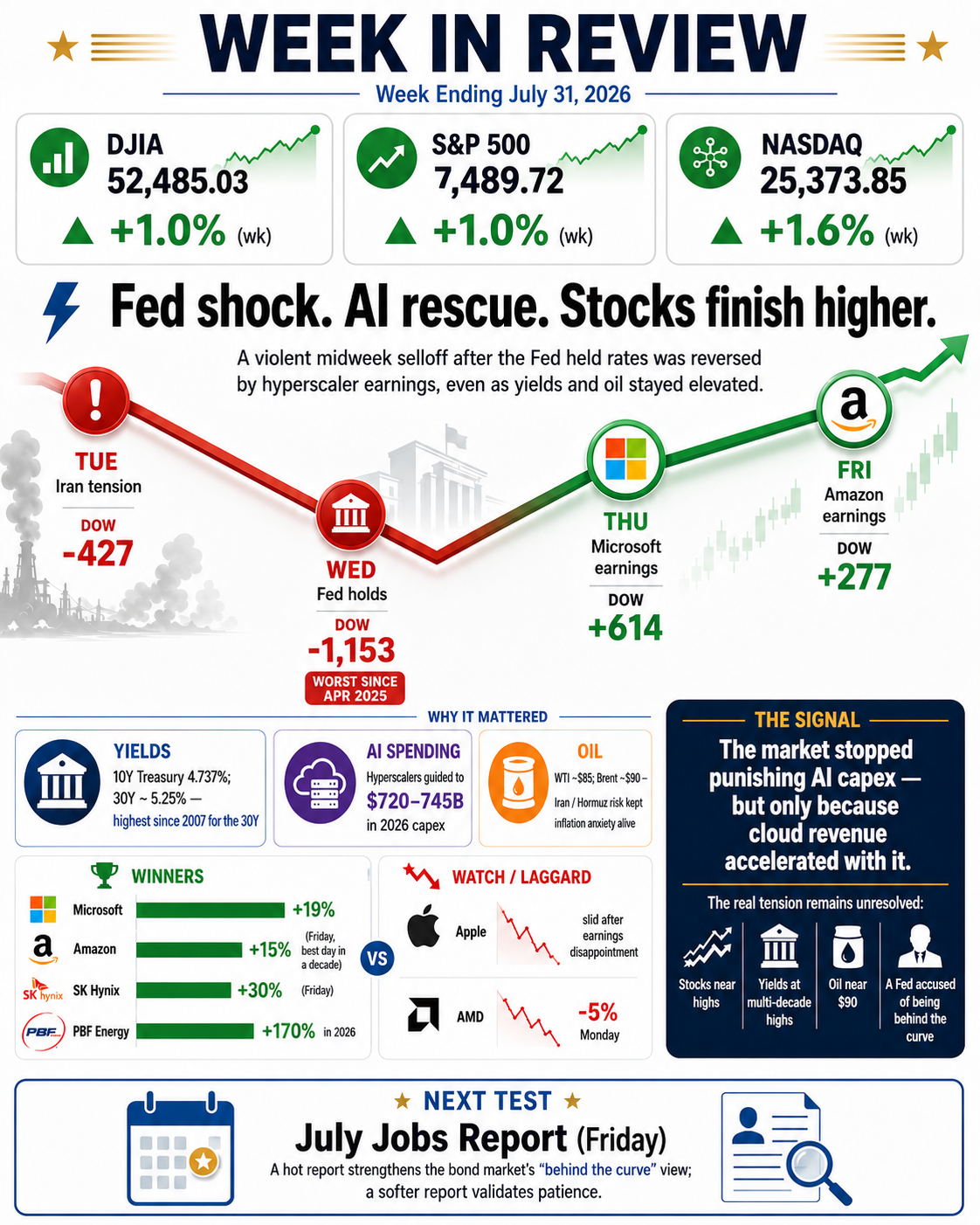
Fed’s hold triggers worst Dow drop since April 2025 (-1,153 points) as bonds scream “behind the curve”—then hyperscaler earnings stage a furious rescue: Microsoft +19% for the week, Amazon’s best day in a decade, $720-745 billion in 2026 capex plans; 30-year yield hits highest since 2007
One of the most violent whipsaw weeks of the cycle ended with all three indexes higher and the Dow closing out a fourth straight winning month (+0.7% for July)—a result that looked impossible at Wednesday’s close. Friday: the Nasdaq rose 1% to 25,373.85, the S&P 500 added 0.7% to 7,489.72, and the Dow gained 276.97 points (+0.53%) to 52,485.03, capping weekly gains of roughly 1% for the blue chips and broad market and 1.6% for the Nasdaq. The week’s fulcrum was Wednesday’s FOMC decision: the Fed held rates steady at Kevin Warsh’s second meeting—despite markets having priced meaningful odds of an immediate hike—and the bond market revolted, treating the pause as evidence the central bank is falling behind on inflation. The Dow collapsed 1,153.18 points (-2.19%) to 51,594.14, its worst single-day decline since April 2025; the S&P fell 1.52% to 7,316.15; and the Nasdaq dropped 1.74% to 24,442.94, closing more than 10% below its all-time high—formal correction territory. Treasury yields surged all week: the 10-year touched 4.737% intraday Friday, its highest since January 2025, while the 30-year spiked to roughly 5.25%—levels not seen since 2007. The Iran war fed the inflation anxiety: Trump vowed to “hit Iran hard” after an attempted surprise attack on American forces, driving Brent up 6.6% Wednesday to $89.61 and WTI up 6.4% to $84.31.
Then the hyperscalers rewrote the script. Microsoft’s Wednesday-evening report—headlined by Azure growth—sent the stock up 16% Thursday and 19% for the week, powering a broad rebound: the Dow surged 613.92 points (+1.2%) Thursday, the S&P climbed 1.7%, and the Nasdaq jumped 2.8% to snap a six-day losing streak. Amazon followed Thursday night with surging revenue that produced a gain exceeding 15% Friday—its largest single-day advance in more than a decade. Collectively, the four hyperscalers (Amazon, Microsoft, Meta, Alphabet) guided to $720-745 billion in cumulative 2026 capital spending—and after three weeks of punishing exactly that behavior, the market cheered, because this time the spending arrived attached to accelerating cloud revenue. The reversal rippled globally: South Korea’s Kospi staged an unprecedented 18% single-day surge Friday led by SK Hynix hitting its 30% daily limit, U.S. chip ETFs rallied, and Europe’s Stoxx 600 touched a record. JPMorgan analysts noted Wednesday that hedge funds have likely finished the deleveraging that drove the chip complex into bear territory. The exception was Apple: shares slid Friday after Thursday’s report disappointed on China and Services, keeping the stock out of the celebration. Earlier in the week the tape had been fragile—Monday’s session was flat-to-mixed with semis still falling (AMD -5%), and Tuesday saw the Dow drop 427 points as Iran tensions built into the Fed meeting.
Beneath the drama, the inflation-versus-growth tension sharpened rather than resolved. Oil ended the week choppy but elevated—WTI near $85 and Brent near $90 Friday as Strait of Hormuz traffic began faltering again amid re-escalated hostilities, though crude finished marginally lower (-0.76%) for the week after Wednesday’s spike. The Iran war’s clearest equity beneficiaries hit new highs: refiners PBF Energy (+170% in 2026), Delek, Par Pacific, and HF Sinclair all closed at records Thursday on historically strong crack spreads, with Valero, Marathon Petroleum, and Phillips 66 just below theirs. University of Michigan sentiment showed a broad pickup despite elevated gas prices, and AAII bearishness eased slightly to 42.1%—still far above the 31% historical average, extending a below-average-optimism streak running since January 2025. GE Healthcare posted a record $23.9 billion order backlog. Reformation Inc. debuted on the NYSE Friday. The week’s closing configuration is uncomfortable but coherent: stocks near highs, yields at multi-decade highs, oil near $90, and a Fed that just told markets it can wait—setting up next Friday’s July jobs report as the next referendum on whether patience looks prudent or negligent.
Weekly Performance
| Index | Close | %Chg (wk) |
|---|---|---|
| Dow Industrials | 52,485.03 | +1.0% |
| S&P 500 | 7,489.72 | +1.0% |
| Nasdaq Comp | 25,373.85 | +1.6% |
| Dow (July) | +0.7% | 4th month |
The Whipsaw
| Session | Dow Move |
|---|---|
| Tue (Iran tension) | -427 |
| Wed (Fed holds) | -1,153 (worst since Apr ’25) |
| Thu (MSFT +16%) | +614 |
| Fri (AMZN +15%) | +277 |
Yields & Oil
| Indicator | Level | Note |
|---|---|---|
| 10-Yr Treasury | 4.737% | Since Jan ’25 |
| 30-Yr Treasury | ~5.25% | Since 2007 |
| WTI Crude | ~$85 | +6.4% Wed |
| Brent Crude | ~$90 | Hormuz faltering |
Weekly Movers
| Stock | Notable Move |
|---|---|
| Microsoft (MSFT) wk | +19% |
| Amazon (AMZN) Fri | +15% (best in decade) |
| SK Hynix (Seoul) Fri | +30% (limit) |
| Kospi (Korea) Fri | +18% |
| PBF Energy (2026) | +170% |
| Refiners (Thu) | Record highs |
| Apple (AAPL) Fri | Slid |
| AMD Mon | -5% |
Week Ahead
- July Jobs Report (Fri): The referendum on the Fed’s pause. A hot print with yields already at 2007-era highs (30Y) would validate the bond market’s behind-the-curve verdict; a soft one buys Warsh’s patience credibility into September.
- Correction Watch: The Nasdaq closed Wednesday >10% off its high before rebounding to -~7%. Whether Thursday-Friday marked the low depends on follow-through from the hyperscaler rally—and on yields not making new highs.
- $720-745B Capex, Now Blessed: Markets flipped from punishing AI spending to cheering it in 48 hours because cloud revenue accelerated alongside. That approval is conditional—memory names (SK Hynix limit-up, Kospi +18%) are now pricing the demand side aggressively again.
- Iran Retaliation Cycle: Trump’s vow to “hit Iran hard” after the attempted attack on U.S. forces, plus faltering Hormuz traffic, keeps $90 Brent live. Refiners at records are the market’s tell on sustained crack spreads.
- Yields vs. Equities: Stocks rallied Friday despite the 10Y topping 4.7%—earnings strength overwhelming rate pressure. That works until it doesn’t; 5.25% on the 30Y reprices mortgages, credit, and every DCF in the market.
Term of the Week
Behind the Curve: Bond-market shorthand for a central bank whose policy rate is too low relative to inflation’s actual trajectory—meaning it reacts to price pressures after they build rather than preempting them, and will ultimately need to tighten more, later, at higher cost. Wednesday delivered a textbook demonstration. The Fed held rates steady at Kevin Warsh’s second meeting, choosing patience despite PCE near 4% and oil back at $90 on the Iran war’s re-escalation. Equities initially read the hold as dovish relief—then the bond market overruled them: the 30-year Treasury spiked toward levels unseen since 2007 and the 10-year pushed past 4.7%, its highest since January 2025. The Dow’s 1,153-point collapse—its worst session since April 2025—followed the bond signal, not the Fed statement. The mechanics: when investors believe a central bank is behind the curve, they demand more compensation for holding long-dated debt, because delayed tightening implies inflation runs hotter for longer and the eventual response must be harsher. Short rates stay anchored by the Fed’s inaction while long rates rise on inflation fear—a bear steepening of the yield curve, exactly the pattern that punished stocks Wednesday. This differs fundamentally from yields rising on growth optimism, which comes paired with earnings upgrades; credibility-driven increases compress valuations with no offsetting benefit. The precedents are sobering—1994’s bond rout and the 2021-2022 “transitory” episode both began with markets concluding the Fed was late, and both required aggressive catch-up tightening. But the week also showed the counterforce: Thursday and Friday’s hyperscaler-led rally proved sufficiently strong earnings can absorb rate pressure, with stocks closing the week higher even at 5.25% on the 30-year. Next Friday’s jobs report is the referendum: a hot print confirms the bond market’s verdict and forces the September hike debate forward; a cooling print vindicates Warsh’s patience. Either way, the week established this cycle’s rule—the Fed sets the policy rate, but the long end of the Treasury market sets the terms.
