
Week Ending August 7, 2026
DJIA
54,036.93
+3.0% (wk)
S&P 500
7,757.64
+3.6% (wk)
NASDAQ
26,690.62
+5.2% (wk)
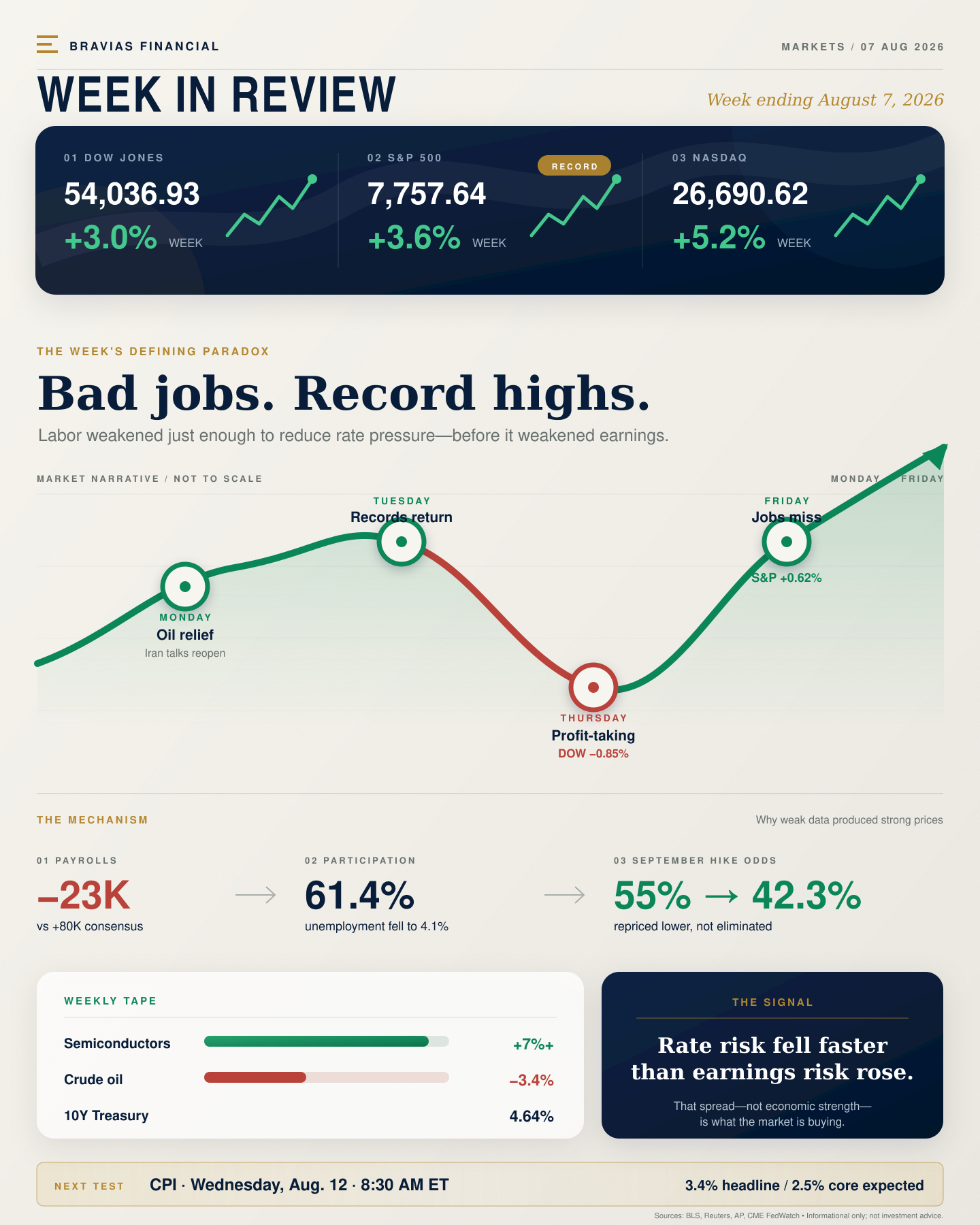
Economy unexpectedly loses 23,000 jobs in July—and stocks rally to records as September hike comes off the table; S&P posts best week since April at 7,757.64 after first-ever close above 7,700; Dow tops 54,000; chips bounce 7% as SpaceX surges 19%
The bond market’s behind-the-curve verdict met its rebuttal Friday in the form of the strangest jobs report of the cycle: the U.S. economy shed 23,000 jobs in July—economists expected an 80,000 gain—yet the unemployment rate fell to 4.1%, because the labor force itself keeps shrinking. Markets chose the doves’ reading. The S&P 500 advanced 0.62% to a record close of 7,757.64—capping a 3.6% weekly gain, its best week since April, after closing above 7,700 for the first time ever earlier in the week—while the Nasdaq climbed 1.3% Friday to 26,690.62 (+5.2% week) and the Dow added 151.83 points to 54,036.93 (+3.0% week), clearing 54,000 for the first time. Semiconductors led the repair: the iShares Semiconductor ETF finished the week up more than 7%, extending the rebound that began with the hyperscalers’ $720-745 billion capex blessing. Treasury yields fell as traders took a September rate hike off the table—money markets still project one 2026 hike, but not before December—and the dollar weakened. It was the second straight weekly gain, completing a round trip from correction territory: the Nasdaq that closed more than 10% below its high on Fed day nine sessions earlier ended this week roughly 2% from records.
The week built to Friday through a tug-of-war between record-setting momentum and late-week caution. Monday’s session surged as oil slid on renewed Iran talks; Tuesday delivered record closes for the S&P 500 and Dow as the tech comeback continued, with SpaceX and AMD reporting earnings; Wednesday saw profit-taking after the records; and Thursday closed broadly lower (Dow -0.85%, S&P -0.18%, Nasdaq -0.06%) on disappointing earnings reactions and Middle East nerves. The earnings tape stayed strong underneath: Airbnb jumped after hours Thursday on beats and traded up nearly 9% pre-open Friday, while Cloudflare soared 16% on an upbeat full-year and current-quarter outlook. The Trade Desk fell more than 27% pre-open Friday after its advertising results, and ResMed slid 5.5%. SpaceX delivered its best stretch since going public: shares closed nearly 14% higher Wednesday after the first earnings report as a public company, added 12% Friday, and finished up almost 19% for the week on growing optimism toward fundamentals. The test arrives immediately—the first lockup expiration puts more than 900 million shares in position to enter the market. Challenger data showed U.S. employers announced 33,429 job cuts in July, down 27%: layoffs remain historically restrained even as hiring stalls, the signature of a frozen rather than collapsing labor market.
The jobs report’s internals explain why the celebration deserves an asterisk. The unemployment rate fell for the “wrong” reason: labor force participation dropped to 61.4%, down 0.7 percentage point this year as nearly 1.4 million people exited the workforce—a vanishing-worker dynamic that flatters the jobless rate while shrinking the economy’s productive base. The Fed-watch tension is live: markets took September off the table, but policymakers may read the lower unemployment rate as evidence of a still-stable labor market, keeping the December hike projection alive. Oil told the geopolitical story in miniature: crude fell 3.44% for the week on Monday’s renewed-talks optimism, then climbed as much as 1.2% intraday Friday on fresh Strait of Hormuz tensions before settling down 0.29%—the war remains a live variable that this week’s rally simply chose to discount. The uncomfortable synthesis: equities at all-time records are now powered by evidence of economic deterioration, a regime that works only as long as the deterioration stays shallow enough to restrain the Fed without denting earnings. Next week’s calendar—Super Micro Tuesday, Applied Materials Thursday—keeps the AI-infrastructure complex in the spotlight just as the chip rebound faces its first post-rally test.
Weekly Performance
| Index | Close | %Chg (wk) |
|---|---|---|
| Dow Industrials | 54,036.93 | +3.0% |
| S&P 500 (record) | 7,757.64 | +3.6% |
| Nasdaq Comp | 26,690.62 | +5.2% |
| SOXX (chips) | Rebound | +7%+ |
| Crude oil | Talks hope | -3.4% |
July Jobs Report
| Indicator | Reading | vs Est |
|---|---|---|
| Nonfarm payrolls | -23,000 | vs +80,000 |
| Unemployment | 4.1% | vs 4.2% |
| Participation rate | 61.4% | -0.7pp YTD |
| Labor force exits | ~1.4M | 2026 YTD |
| Challenger cuts | 33,429 | -27% |
Fed & Rates Repricing
| Indicator | Level | Note |
|---|---|---|
| September hike | Off table | Post-jobs |
| 2026 hike | Still priced | Not before Dec |
| Treasury yields | Fell | Short end led |
| U.S. dollar | Fell | Risk-on |
Weekly Movers
| Stock | Notable Move |
|---|---|
| SpaceX (SPCX) wk | +19% |
| Cloudflare (NET) | +16% |
| SpaceX (SPCX) Wed | +14% |
| SpaceX (SPCX) Fri | +12% |
| Airbnb (ABNB) pre-open | +8.8% |
| SOXX (week) | +7%+ |
| DraftKings (DKNG) | -3% |
| ResMed (RMD) pre-open | -5.5% |
| Trade Desk (TTD) pre-open | -27% |
Week Ahead
- SpaceX Lockup Expiry: More than 900 million shares become eligible to trade just as the stock finally strings together a winning week. Supply meeting renewed optimism is the cleanest test yet of where SPCX’s real clearing price sits.
- Frozen vs. Breaking Labor Market: Job losses with restrained layoffs (Challenger -27%) reads as a hiring freeze, not a collapse. If claims start rising, the benign “Fed-restraining” deterioration becomes earnings-threatening—and the record rally loses its premise.
- December Hike Still Lurking: Markets celebrated September’s removal, but a 2026 hike remains priced. The lower unemployment rate gives hawks cover; watch Fed speakers for whether they bless or fight the repricing.
- AI Hardware Checkpoints: Super Micro (Tuesday) and Applied Materials (Thursday) report into a chip complex up 7% on the week. After the hyperscaler capex blessing, equipment and server guidance either confirms the demand chain or exposes a gap.
- Iran Talks vs. Hormuz Tensions: Oil fell 3.4% on renewed negotiation hopes, then spiked Friday on fresh Strait tensions. The war’s market weight is fading with each cycle—but the risk premium remains one headline away.
Term of the Week
Labor Force Participation Rate: The share of the working-age population either employed or actively seeking work—the denominator that determines what the unemployment rate actually means. July’s report made it the most important number nobody usually reads: the economy lost 23,000 jobs, yet unemployment fell to 4.1%—resolved entirely by participation dropping to 61.4%, down 0.7 point this year as nearly 1.4 million people exited the labor force. The arithmetic is simple: someone who stops looking vanishes from both sides of the ratio, so when exits outpace job losses, the rate improves while the economy deteriorates—a shrinking pie recorded as a rising share. That split Friday’s reaction. Traders took the headline weakness at face value—September’s hike came off the table, yields fell, stocks hit records—while Fed watchers noted policymakers may read 4.1% as a still-tight labor market, keeping December alive: a smaller workforce sustains wage pressure even as hiring stalls, and fewer workers producing is itself inflationary at the margin with PCE near 4%. Three investor implications: headline unemployment is currently the least reliable labor indicator (watch payrolls, participation, and claims); the rally’s premise requires the hiring freeze to stay a freeze—Challenger’s 33,429 July cuts (-27%) show employers hoarding workers, and if that breaks, bad news reverts to simply bad; and a shrinking-workforce economy structurally favors the automation and AI-infrastructure plays that led this week, which substitute capital for scarce labor. The records were built on a paradox—and paradoxes in market regimes tend to resolve suddenly rather than gently.
